
Sexual Misconduct Allegations & Refusal of Independent Investigation Lead to Mass Exodus at Blessed Hope Chapel
Former members allege a cover-up involving Pastor Joe Schimmel and his daughter after misconduct claims, conflicting accounts, and the refusal of an independent investigation led to a mass exodus of 50+ departures.

The Berean Examiner
Investigative Team
This investigation is temporarily under editorial review while we incorporate additional information provided by affected parties. The full article will be available shortly. We are committed to accuracy and fairness in our reporting.
Editorial Note — Privacy & Source Identification
This investigation emerged from multiple anonymous former congregants who came forward to The Berean Examiner independently over time — each bringing a portion of the same account. No individual referred to by name or pseudonym in this article was directly interviewed by The Berean Examiner. The accounts of those described throughout — including individuals identified by pseudonyms such as Jane, Ed, Jacob, and Debbie — were relayed to this publication by former congregants who had personal knowledge of their experiences: people who heard them speak, witnessed events alongside them, or were told about these matters directly. Those former congregants chose to come forward because they believed this story needed to be told, and because relaying accounts through shared testimony — rather than direct attribution — was the only way to protect people they cared about from confrontation or retribution by church leadership. For the same reason, the alleged victim is not named and is referred to throughout as “Daniel.” All source identities are withheld. The account presented here is drawn from converging reports brought to us by multiple independent former members, supported by documented letters and written communications reviewed for this report. No single source is relied upon — the pattern described was corroborated across separate individuals, in separate conversations, over time.
Right of Reply: Prior to publication, The Berean Examiner transmitted a detailed written request for comment to Blessed Hope Chapel and Good Fight Ministries, addressed to Pastor Joe Schimmel, and to Pastor Chad Davidson, identifying the specific allegations and findings contained in this report and inviting a full written response. No response was received as of the date of publication. This report will be updated if a substantive response is provided.
Allegations vs. Established Facts: Throughout this report, conduct attributed to named individuals on the basis of witness testimony is described as alleged unless independently established by documentary evidence reviewed by this publication. Sections of this report that offer biblical analysis, doctrinal assessment, or editorial conclusion are the opinion of The Berean Examiner and are clearly framed as such. Readers are encouraged to weigh the evidence and reach their own conclusions.
Relayed Testimony: Where accounts are described as relayed through intermediaries — former members who heard directly from those involved — this publication has assessed the credibility, consistency, and independence of each relay chain. Accounts included in this report were corroborated by at least one additional independent source or by documentary evidence before inclusion. The relayed-testimony methodology employed here is consistent with standard investigative journalism practice when direct subjects cannot be identified or would face retaliation for speaking publicly.
Organizational Ties: Blessed Hope Chapel & Good Fight Ministries
Blessed Hope Chapel operates in close connection with Good Fight Ministries, an apologetics and media outreach organization also founded and led by Pastor Joe Schimmel since 1987. Schimmel serves as Senior Pastor of Blessed Hope Chapel (since 1990), and key staff members, including those involved in the allegations, hold overlapping roles across both entities. Both share operational ties in Simi Valley, California (including the church’s address at 23 W Easy St, Suite 204), and are presented as interconnected “sister” ministries on their respective websites. As a result, the allegations of misconduct, cover-up, and refusal of independent scrutiny at Blessed Hope Chapel extend implications to Good Fight Ministries through this shared leadership and structure.
More than fifty people left Blessed Hope Chapel within the span of months. They were not strangers to each other or to the ministry — they were families who had served, given, worshiped, and in many cases raised their children there over years and decades. Their departures were not coordinated. They were convergent.
What The Berean Examiner received, over time, was not a single complaint amplified by supporters. It was a mosaic — former members who came forward independently, in separate conversations, over separate months, each bringing a piece of the same picture. Many had no contact with each other. Several had observations the others didn’t have. What they shared was a pattern: the same institutional responses, the same deflections, the same invisible walls appearing in the same places every time someone asked a question that leadership did not want to answer.
This investigation documents that pattern. The written correspondence, firsthand accounts, and documented evidence reviewed for this report describe a ministry that had developed, over time, a consistent mechanism for protecting itself from accountability. One incident ultimately forced the community to compare what each had been quietly carrying. But the pattern it revealed had been building long before that incident occurred — and long before anyone outside the church knew to ask about it. Letters, text messages, and witness testimony reviewed for this article indicate that the incident at the center of that reckoning involved a young man referred to throughout this investigation as Daniel, and alleged conduct by Holly Davidson — the wife of Pastor Chad Davidson and daughter of senior pastor Joe Schimmel — that multiple former members who read the written record described as a serious boundary violation.
What the Congregation Was Already Seeing: The Patterns Before Anyone Compared Notes
Long before any single incident prompted a community reckoning, the patterns were already there — and already being discussed. Anyone who attended Blessed Hope Chapel with any regularity will tell you that wrestlers in the Sunday service audience were a consistent and visible feature of the congregation. Chad Davidson, who served simultaneously as a competitive wrestling coach and a youth pastor at Blessed Hope, had a well-documented practice of drawing young men from his athletic program into the church — not accidentally, but systematically, binding the spiritual and the athletic under the same roof of influence. “Elite wrestlers” were expected to follow Chad to church, bringing with them whatever loyalty had already been built through hours of submission to his authority on the mat. Trips to Mexico, Costa Rica, and various ministry outings were presented as opportunities, but the dual authority Chad wielded over young men’s bodies and souls was not subtle. It was observable to the whole congregation.
What multiple witnesses also observed — and discussed openly among themselves, without any central complaint or formal process to organize around — was a pattern of conduct by Holly Davidson at public wrestling events that struck many as deeply incongruous with her role as a pastor’s wife. According to accounts shared independently among former members and family witnesses, Holly would appear at these events in clothing described by multiple attendees as conspicuously inappropriate — including what witnesses specifically recall as skin-tight leather pants, worn in full public view at events where young male athletes were present. More than one family corroborates this independently, without coordination.
What struck those witnesses equally was the nature of Holly’s interactions with the wrestlers themselves — described by those present as “way too familiar” for a coaching spouse or a woman in pastoral leadership. These observations were not held privately. Former members report that people talked about it — in the parking lot, between families, in quiet conversations after services. The question circulating among those who noticed was not complicated: Why does she present herself this way? And why does Chad allow it?
The doctrinal weight of that question should not be lost. Blessed Hope Chapel and Good Fight Ministries operate under an explicit theological framework that emphasizes modesty, self-control, and respectable apparel as markers of godly character — particularly for those in positions of spiritual influence. The Apostle Paul’s instruction in 1 Timothy 2:9–10 calls those in Christian leadership to clothe themselves in “respectable apparel, with propriety and modesty,” specifically in contrast to attire designed to draw the eye. That a pastor’s wife would appear repeatedly at public events in clothing multiple community members independently flagged as sensually provocative — and that no correction or accountability appears to have followed — represents a profound dissonance between the doctrinal standard publicly preached and the conduct permitted behind Chad Davidson’s name. The congregation noticed. And they noticed separately, without organizing around a grievance.
Alongside this, former congregants describe a church culture in which spiritual loyalty and personal identity became increasingly tightly bound to the leadership circle at the top. Pastor Joe and Chad Davidson consistently communicated — through sermons, social dynamics, and the way leadership carried themselves — that Blessed Hope was not merely a good church, but uniquely faithful, while other churches were quietly treated as second-rate or spiritually immature by comparison. The message wasn’t always explicit, but it was pervasive: those inside were serious about God; those outside, or those who left, were suspect. This posture was endemic to the culture — not the quirk of any one person, but the tone set by leadership and absorbed throughout the congregation. Beneath that surface-level zeal, something had been forming: a system in which loyalty to a small group of leaders at the top was slowly becoming the measure of spiritual maturity.
It was against this backdrop — the wrestler pipeline, the publicly observable conduct that no one was correcting, the spiritual elitism, the culture of loyalty over scrutiny — that the situation involving a young man known throughout this investigation as Daniel eventually came to light. According to multiple former congregants who knew him during his teenage years, Daniel first entered the orbit of Chad and Holly Davidson around 2016, when he was approximately 16 years old. Chad was then about 28 and served as both his wrestling coach and youth pastor at Blessed Hope Chapel. Holly was 27.
Daniel’s experience did not create these patterns. It exposed them. And when it did, the former members who had been carrying their own quiet observations for years finally had a reason to compare what each had been separately holding. What emerged from that comparison — across separate conversations, among people who had not previously connected their experiences — is what this investigation documents.
Former members describe a young man already under intense pressure when he first came into the Davidsons’ orbit — depressed, anxious, and dreading every walk toward the wrestling room. At the time, many believed it was simply a “sports problem.” What they did not yet realize was that the same man breaking him down as a coach would soon become the spiritual authority shaping nearly every aspect of his life.
Over the next several years, according to those familiar with the situation, the line between coach and pastor blurred significantly — through the same mechanism the congregation had already been watching operate publicly. The same dynamics, the same co-option, the same unchecked latitude simply took on new clothes.
As time passed, cracks began to show. Multiple former members who remained close to the situation noticed recurring patterns: surface-level discipleship with little genuine care for those under its influence, an explosive confrontation from Chad during the Costa Rica missions trip that witnesses describe as having left a visible and unsettling mark on those present, and a dynamic in which the church’s authority increasingly displaced the young man’s connection to his own family’s spiritual oversight — not by his choosing, but by the structure Chad had built around him.
What began as one community’s growing awareness of a pattern gradually unraveled into a broader reckoning. Over time, as more families left the church for related reasons, multiple former congregants started connecting what each had observed independently. What they once carried separately began to look, together, like a consistent and deliberate system of spiritual control, boundary violations, and institutional self-protection.
When the Mask Slipped From the Pulpit
The moment that crystallized the situation for many in the former-member community arrived during what appeared to be a routine sermon. From the pulpit, Pastor Joe asserted that in more than thirty years of ministry he had never once been involved in an argument.
The claim did not land quietly. According to multiple former congregants who were present or heard accounts of the sermon shortly afterward, the statement registered as false — not only for those familiar with Daniel’s specific experiences, but for numerous individuals across the congregation who had their own independent knowledge of Pastor Joe’s conduct over the years. Former members speaking with The Berean Examiner report that people who had no direct connection to Daniel’s situation nonetheless knew the claim was untrue based on things they had personally witnessed or been told within the church community.
Those familiar with the confrontations Daniel experienced — including a documented thirty-minute encounter during a church retreat — recognized the statement as particularly striking. But witnesses make clear that Daniel’s account was not the only basis on which the claim was disputed. According to those who have spoken widely within the former-member community, the collective reaction was not one of isolated doubt but of widespread recognition: a claim delivered from a place of moral authority that many who heard it knew, through their own experience, did not reflect reality.
Former congregants who have since connected — many having left the church independently, for different reasons, over different years — describe the pulpit claim as one of the most consistently cited moments in the broader community’s account of how leadership operated. It was not a story one person remembered. It was a story that circulated widely, with multiple independent witnesses attaching their own corroboration to it.
“The Bible is unambiguous: elders must be 'blameless' and 'not quarrelsome' (1 Timothy 3:2–3), and truthfulness is non-negotiable — 'You shall not bear false witness' (Exodus 20:16). Any public statement that contradicts known reality, delivered from the place of teaching authority, requires scrutiny.”
1 Timothy 3:2–3 / Exodus 20:16
This pattern — public image preservation over private truth-seeking — stands in direct contrast to the biblical call for shepherds to know and care for their sheep (John 10:14; 1 Peter 5:2–3). That so many former members, drawing on separate experiences and separate conversations, arrived at the same conclusion about that moment speaks not to a single grievance but to a community-wide reckoning with what it had witnessed from the front of the room.
The Night 'Accountability' Meant Being Alone in a Private Room
According to witnesses familiar with the events, months later at a young adults gathering, Chad and Holly insisted on a private meeting in a room with the young man alone — no third party, no oversight. What followed, witnesses say, was not accountability — it was accusation. Emotions escalated. Chad yelled without eye contact, dismissing him as arrogant. The relationship ended in that room, exposing what witnesses describe as a system of isolation and accusation masquerading as pastoral discipline.
The Deeper Betrayal: Holly Davidson's Misconduct and Chad's Complicit Silence
By the time multiple witnesses were comparing their accounts, the narrative they had assembled already included years of depression from high school wrestling, forced separation from his family’s church, spiritual elitism at Blessed Hope Chapel, severe anxiety attacks, failed discipleship under Chad Davidson, silenced confrontations, and an explosive “discipline” meeting in a private room.
Running through all of those accounts was a thread that multiple former members who were close to the situation describe as the most serious element of what unfolded: the conduct of Holly Davidson, Pastor Chad’s wife and a leader in youth ministry at Blessed Hope Chapel.
According to multiple former members familiar with the full scope of what occurred, Holly’s conduct toward Daniel represented the most significant boundary violation in this account — crossing moral and ethical lines that should never be crossed by a married woman in spiritual leadership, particularly across an extended period with a young man under their shared influence and care.
According to witnesses and supporting documentation, those actions deeply wronged the young man at the center of this account, jeopardized his ministry prospects and reputation, and occurred in a context where boundaries were supposed to be rigorously upheld.
According to multiple former members and witnesses, Pastor Chad allowed Holly’s conduct to escalate to levels unbecoming of a pastor’s wife and young adult leader. Rather than intervening or addressing what he should have known or suspected, Chad ignored or permitted it — making him partially responsible for the resulting harm.
That pattern of complicity did not begin behind closed doors. As detailed by multiple witnesses earlier in this investigation, Holly’s behavior was observable at public wrestling events — events Chad organized, coached, and attended in his full capacity as head coach and pastor. He was present when, according to multiple family witnesses, his wife appeared in clothing community members described as conspicuously inappropriate for a married woman in pastoral leadership, and engaged with young male athletes in ways multiple attendees characterized as “way too familiar.” Families talked about it openly. Former members report that the question circulating among those present was not subtle: Why does she present herself this way — and why does Chad allow it? Chad’s silence in those public settings, in front of the same families who would later make up the departing congregation, was its own form of authorization. In the assessment of those who were there, the enabling did not begin in private. It began in plain sight.
The doctrinal weight of this cannot be set aside. Blessed Hope Chapel and Good Fight Ministries publicly and repeatedly teach that modesty, self-control, and respectable apparel are not peripheral concerns but defining marks of godly character — especially for those exercising spiritual authority. A pastor who enforces those standards from the pulpit while permitting his own wife to conduct herself publicly in a manner that directly contradicts them has not merely failed to lead. He has demonstrated, through action and inaction alike, that the standard he preaches applies to everyone except those closest to his own name. That is not a failure of oversight. That is a failure of character.
“He was deeply wronged by what she did — that much is not in dispute among those who were close to the situation.” — Former member familiar with the account
Chad’s silence and inaction compounded the betrayal at every stage — from the wrestling mat to the church pew to the private conversations no one was supposed to have — binding the couple together in shared accountability for the misconduct that followed.
The 2021 Secret Beach Meeting Arranged by Lisa Schimmel
One of the earliest incidents cited by witnesses as evidence that the situation was mishandled occurred in 2021, when a private meeting was arranged between Holly Davidson and the young man at the center of the concerns — without the knowledge of church leadership, the elders, or his family.
According to former members familiar with the details, when concerns about what was described as an inappropriate emotional and physical entanglement between Holly and a young man under her spiritual influence were raised with Lisa Schimmel, she arranged for the two to meet privately — rather than bringing the matter to the elders or informing the men responsible for oversight in the church.
According to written correspondence reviewed for this report and accounts relayed by former members familiar with the arrangement, the meeting took place at Zuma Beach. The details of how it was arranged — and the explicit instruction that none of those involved were to share what had occurred with anyone, including Pastor Joe, Chad Davidson, or the parents — were later documented by the family in a formal letter addressed to Lisa Schimmel.
Former members who later learned of the meeting said it raised serious questions about judgment, accountability, and the handling of potential misconduct inside the leadership circle — and about whether the secrecy surrounding it was designed to protect the family rather than the people involved.
Among the most striking aspects of this incident to former members was the question it raised about Pastor Joe Schimmel himself. Multiple former congregants, when they learned what Lisa had done, describe asking the same question independently: How could this happen under Pastor Joe’s watch? According to those familiar with the reactions within the former-member community, the question was not rhetorical. It was pointed. A pastor who has spent decades publicly calling out spiritual compromise in other ministries, who preaches standards of biblical order in the home, whose entire public ministry brand rests on discernment — that pastor’s own wife acted unilaterally outside her husband's authority to handle a potential misconduct situation involving their daughter, and he either did not know or did not stop it.
For many former members, this was not an isolated lapse — it was the opening chapter of a pattern. Lisa Schimmel, by all accounts in the former-member community, acted unilaterally. She did not bring the matter to her husband. She did not go through the elders. She did not involve the family. She went her own direction — and the consequences, according to those familiar with the timeline, cascaded from that point forward. The letter that later identified the beach meeting as “the error that led to years of instances that should never have occurred” placed the foundational accountability failure precisely there: on what Lisa did when no one was looking.
But the pattern does not stop with Lisa. Former members who watched these events unfold noted, with unmistakable consistency, that the same structural failure ran through both households at the center of this investigation. Chad Davidson — the man Paul’s standard requires to govern his own household before governing the church — could not, or would not, govern Holly. And Joe Schimmel — the senior pastor, founder of a discernment ministry, the self-described “top of the pyramid” — appears to have been unable, or unwilling, to govern Lisa. In both cases, the wife did not act in submission to the authority the Scripture places on the husband. In both cases, the husband’s response was either ignorance, passivity, or implicit approval. And in both cases, the church bore the consequences.
Questions Former Congregants Raised — Independently, Across the Community:
If Pastor Joe preaches biblical order in the home, how did his own wife make a unilateral decision of this magnitude — secretly, with no elder involvement — and face no accountability for it?
If Chad Davidson is disqualified from pastoral office because he cannot govern his household, what does it say about Pastor Joe, whose wife and daughter both operated outside the boundaries of the oversight structure he was responsible for maintaining?
A pastor whose ministry is built on exposing compromise in other churches — whose brand is discernment — could not see what was happening inside his own home. Or he saw it and said nothing. Which is worse?
Scripture’s standard for overseers was not written to be applied selectively to other churches. It was written to be applied to the men who occupy the office. First Timothy 3:4–5 does not exempt a pastor from the household governance test because he has been in ministry for thirty years, or because his organization has a strong public reputation, or because his wife is the church bookkeeper. It asks a simple, disqualifying question: does this man manage his own household well? And the documented record — Lisa’s unilateral secret beach arrangement, Holly’s years of unaddressed boundary violations, the chain of events that followed precisely because the women closest to the leadership circle acted without the oversight the structure required — answers that question in plain terms.
Former members describe this not as a single lapse but as a structural reality that was visible, in hindsight, long before the crisis became public. The household of the senior pastor was not in order. The household of his son-in-law was not in order. And the institution they built together — one whose public purpose is accountability for others — had no mechanism to acknowledge or address the disorder it contained.
Failed Internal Accountability
Because the allegations involved Holly Davidson — the daughter of senior pastor Joe Schimmel and wife of elder Chad Davidson — multiple witnesses say it was clear that no fair examination was possible within the same tightly knit leadership circle. Concerns were therefore brought privately and scripturally to Pastor Jonathan Ball, a respected figure in the fellowship’s extended network known for his commitment to biblical integrity and standards. The hope, according to those familiar with the process, was that Pastor Jonathan would objectively evaluate the full testimony — including Holly’s serious boundary violations — against Scripture and elder qualifications (1 Timothy 3:2–7; Titus 1:6–9).
After meeting privately with Chad, Holly, Joe, and Lisa and hearing only their categorical denials, Pastor Jonathan returned unwilling to challenge leadership’s account.
Witnesses who had trusted Jonathan’s reputation were deeply dismayed when it later emerged that Holly had admitted to at least some degree of inappropriate conduct or crossed boundaries with Daniel. Knowing this admission existed, they concluded Jonathan should have confronted the contradictions and called for repentance — but he appeared instead to follow the system’s pattern: quietly burying the issue, protecting the core leadership’s reputation, and leaving the vulnerable without justice or change. In other words, this response did not resolve sin — it shielded it.
The Lack of Courage in Battle: Elders Who Knew But Would Not Stand
In addition to Pastor Jonathan Ball’s refusal to challenge leadership, witnesses report that former elder John Heeber was also urged to demand a third-party investigation into Holly Davidson’s conduct.
According to multiple witnesses, Heeber was directly challenged by former members demanding to know why he had not acted on behalf of those who had been harmed. Heeber reportedly replied that he had not known — but witnesses maintain that he did have knowledge of the allegations against Holly, Chad, and the elders’ handling of what had unfolded.
Witnesses further report that John Heeber told former congregants that he was aware of alleged sexual misconduct that was so “explosive” it would force the church to restructure itself and require proper oversight of the elder board. Yet, according to those same witnesses, John took no meaningful action — failing to stand with the vulnerable against the pressure from Pastor Joe and Pastor Chad.
Many former congregants have asked a painful question: What was so difficult for these pastors and elders to simply do the right thing — to defend the vulnerable and demand biblical accountability?
In the context of spiritual abuse within Blessed Hope Chapel, three elders knew of the ongoing issue yet were too afraid to act on it to demand a third party investigation.
“But the cowardly, ..... shall have their part in the lake which burns with fire and brimstone”
Revelation 21:8
“Therefore, to him who knows to do good and does not do it, to him it is sin.”
James 4:17
“But if the watchman sees the sword coming and does not blow the trumpet, and the people are not warned\u2026 his blood I will require at the watchman\u2019s hand.”
Ezekiel 33:6
A powerful leadership verse. When those responsible to warn stay silent, God holds them accountable.
“His watchmen are blind\u2026 they are all dumb dogs, they cannot bark\u2026”
Isaiah 56:10
When elders who possess knowledge and authority choose silence and self-preservation instead of courageous defense of the oppressed, they fail in one of the most basic biblical requirements of spiritual leadership. This lack of courage, witnesses say, not only abandoned those who needed protection but enabled the broader culture of protectionism that ultimately led to the mass exodus.
Blessed Hope's Protective Culture: Minimizing Concerns to Shield Leadership
Several former members who spoke for this report said that what had unfolded in this case did not appear to be an isolated incident, but part of a pattern in how serious concerns were handled at Blessed Hope Chapel. According to letters, testimony, and written communication reviewed for this article, questions involving leadership or family members of leadership were often addressed internally, with the same small group of pastors and elders responsible for both evaluating the concern and determining the outcome.
Former congregants also said that challenging decisions made within the leadership circle often carried relational consequences. Because the situation involved Pastor Joe Schimmel as founder and senior pastor, Chad Davidson as a central ministry leader, and their wives who were also closely involved in church life, some members said they felt there was little room to question the handling of the matter without risking strain in their relationships inside the church.
Several former members stated that when concerns were brought to the elders, the response often appeared to favor the existing leadership decisions, and that requests for further review — including calls for an outside investigation — were not pursued. According to those who later left, this reinforced their belief that the priority had become preserving unity around the leadership rather than re-examining the situation openly.
The Uncorrectable Culture: Why an Independent Investigation Is Now Essential
With every internal process at Blessed Hope Chapel failing — even in the face of serious, substantiated allegations — multiple former members concluded that no meaningful justice or reform could emerge from within. The call for a fully independent, third-party investigation became the central demand: one free from the church’s influence, capable of impartially examining evidence, hearing all testimonies — including those silenced or reframed — and measuring conduct against clear biblical standards rather than institutional loyalty.
This call specifically demanded Holly Davidson’s disqualification from ministry (at least six months, with formal rehabilitation) due to her boundary violations, and Chad Davidson’s as well — particularly given his role as pastor. The Bible holds overseers to rigorous standards: they must be above reproach, self-controlled, and able to manage their own households well (1 Timothy 3:2-5; Titus 1:6-9), so that they can shepherd God’s church. Chad’s failure to intervene in or halt Holly’s inappropriate conduct — despite years of positioning himself and his wife as spiritual models — directly violates these requirements, compromising his ability to lead faithfully and protect the vulnerable.
Far from vengeance, this demand flows from a deep respect for Scripture’s clear standards for those who lead God’s people, and from the testimony of many who witnessed the betrayal firsthand and compounded harm that came from years of institutional protection.
Key Figures in Leadership
The following individuals held positions of authority at Blessed Hope Chapel and/or Good Fight Ministries at the time of the alleged events.

Senior Pastor
Joe Schimmel
Blessed Hope Chapel / Founder, Good Fight Ministries
Founded Blessed Hope Chapel (1990) and Good Fight Ministries (1987), building a national platform through pop-culture apologetics. As senior pastor he sits at the apex of every accountability structure implicated here: Holly Davidson is his daughter, Chad his son-in-law, and Lisa his wife. When formal concerns were raised he declined independent investigation, overseeing an internal review witnesses characterize as protective of the family — and separately elevated Jonathan Ball to head pastor of the Ensenada congregation despite known criminal record and straw purchase allegations. In 2025 he delivered a Men's Retreat session disparaging a departing family in their complete absence; former members describe it as a deliberate effort to control congregational perception before the full record became known.

Youth & Associate Pastor
Chad Davidson
Blessed Hope Chapel
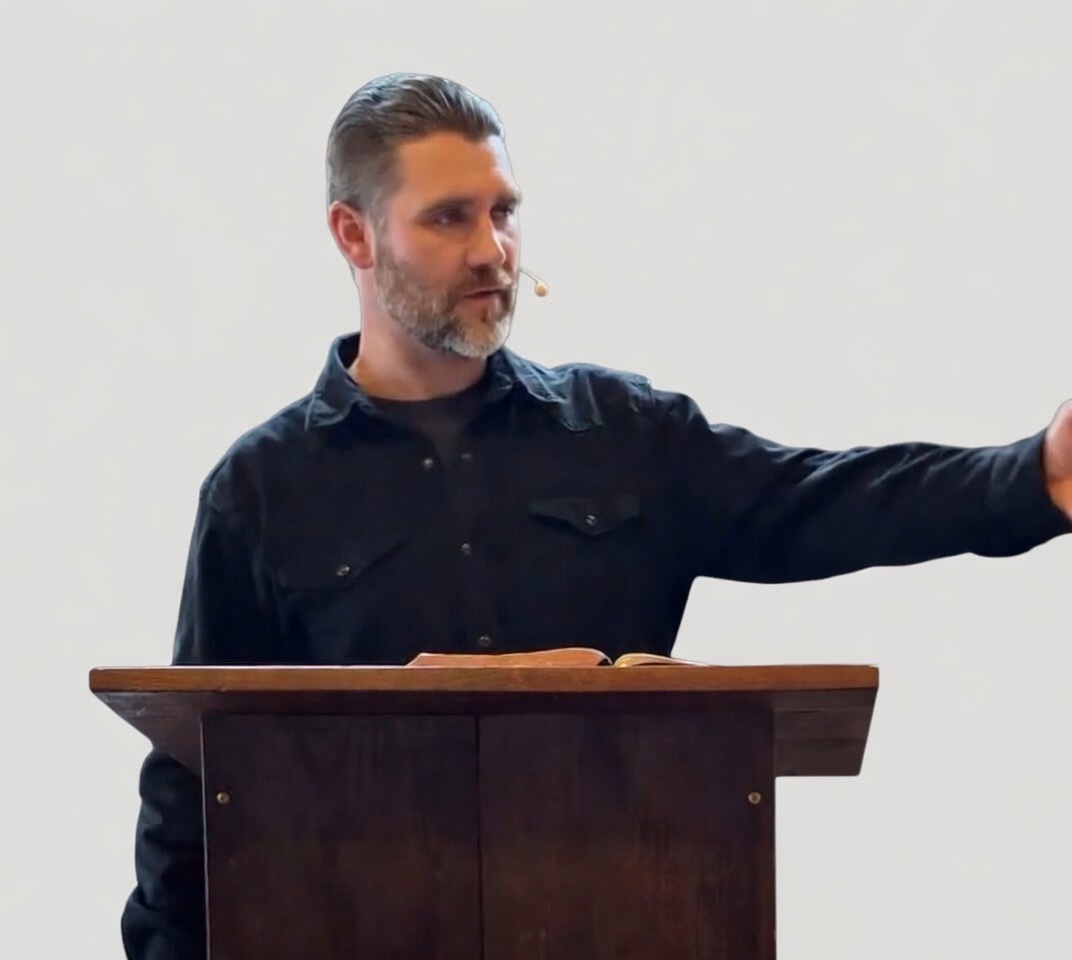
Son-in-law of Joe Schimmel and Youth & Associate Pastor, Davidson built his influence through a calculated dual role — head wrestling coach and church pastor — systematically drawing young men from his athletic program into the ministry and binding their spiritual lives to the same authority that governed their bodies on the mat. Multiple former members allege spiritual abuse and misconduct toward those in his care. When a children's ministry volunteer confronted him, citing scripture and a documented pattern of his own children's disruptive behavior, witnesses describe his response as complete indifference. In June 2024, his alleged preoccupation with non-believing wrestlers he introduced to a Christian youth retreat left the camp under-supervised, allegedly resulting in damage to the spiritual growth of attendees.

Youth Ministry Leader
Holly Davidson
Blessed Hope Chapel
Daughter of Joe and Lisa Schimmel, wife of Chad Davidson, and the primary subject of this investigation. Former members across multiple contexts and years — independently of one another — describe her conduct toward a young man under her pastoral care in strikingly consistent terms, with several calling it the most serious pattern in all witness accounts reviewed. Witnesses also describe public conduct that directly contradicted the modesty and propriety standards her family's ministry taught, with attendees at Chad's wrestling events characterizing her appearance and behavior with young male athletes as conspicuously inappropriate for a married woman in pastoral leadership. These observations circulated openly among congregants, recognized as a dissonance long before the fuller picture of her private conduct came to light.
Pastor / BHC Mexico (Ensenada)
Jonathan Ball
Blessed Hope Chapel — Ensenada, Mexico
Elevated to head pastor of BHC's Ensenada satellite congregation despite leadership's knowledge of a prior criminal record — court records reflect arrests including PC 148.9, PC 12020 (a wobbler weapon charge), and PC 11364, with a single misdemeanor conviction. A former member alleges Ball claimed a felony record and asked them to buy a firearm on his behalf to "test the system" — a solicitation the member declined; under 18 U.S.C. § 922(a)(6), the request constitutes a straw purchase regardless of the underlying conviction. Ball also served as internal mediator in the Holly Davidson matter, reportedly present for admissions by Holly and Chad Davidson, declining to recommend corrective action or escalation.

Former Music Ministry Director
Tony Palacio
Blessed Hope Chapel / Good Fight Ministries
Music ministry director who currently works with Good Fight Ministries. Recorded and distributed a 2025 Men's Retreat session in which Joe Schimmel spent over two hours disparaging a departing family — who had no representative present and were given no opportunity to respond. Distribution of the recording ensured the one-sided account reached the broader former-member community before the full circumstances of the departure were understood. Former members called the act deeply humiliating and a deliberate effort to shape how the congregation would receive what came next.

Former Elder
John Heeber
Blessed Hope Chapel
Former elder at Blessed Hope Chapel who was directly confronted by those raising concerns — questioned about why he had not intervened on their behalf. According to multiple former members, Heeber privately acknowledged awareness of allegations so "explosive" they would force the church to restructure. Despite that acknowledgment, witnesses consistently report he took no meaningful action. His inaction became one of several elder-level failures cited by departing members as evidence of a systemic accountability collapse.

Pastor's Wife / Women's Leadership
Lisa Schimmel
Blessed Hope Chapel
Wife of Senior Pastor Joe Schimmel and Holly Davidson's mother. In 2021, Lisa allegedly arranged a private beach meeting between a young congregant and Holly — without notifying parents, without the knowledge or authorization of the elder board, and outside the boundaries of her husband's pastoral authority. She allegedly acted unilaterally, in the middle of the church's most sensitive active matter. Former members who later learned of the meeting describe it as a significant breach: the pastor's own wife circumventing the very accountability structures her husband was supposed to be leading. Whether Joe was unaware of her actions — or aware and chose not to intervene — both possibilities carry serious weight. In the aftermath of Holly's letter circulating, witnesses also describe Lisa as actively involved in shaping the narrative around Holly's admissions, helping to reframe what the letter contained rather than surface it for honest reckoning. For those asking whether Joe Schimmel can govern a congregation, the conduct of his own household in this matter is not a peripheral question. It is the question.

Pastor
Steve Aguilar
Blessed Hope Chapel
Longtime pastor at Blessed Hope Chapel and a named recipient of the formal September 2025 elder letter. The volume of former members who attempted to enlist Aguilar's help is, by multiple accounts, overwhelming — yet in case after case, witnesses report the same outcome: he received the concern, and nothing followed. According to a person with direct knowledge of how Aguilar has described his own role, he has allegedly told people that he is in charge of "damage control" for the church — a characterization that, if accurate, reframes his repeated inaction not as pastoral neglect but as institutional policy. Former members describe him as an elder who is well known for not following up with those in need, and whose presence in accountability conversations consistently functioned to absorb and neutralize concern rather than act on it.

Bookkeeper
Mary Drinkhall
Blessed Hope Chapel
Church bookkeeper at Blessed Hope Chapel. Allegedly was directed by leadership to explain to at least one concerned congregant that a retired member had reviewed the books and they were "totally good" — a characterization that a longtime congregant says directly contradicts what the reviewer privately stated about the actual scope of his examination.
All individuals named have been given the opportunity to respond. Inclusion in this section does not constitute a finding of guilt or wrongdoing.
Timeline of Key Events
The First Contact
According to multiple former congregants familiar with this period, Chad Davidson — then approximately 28 — was serving simultaneously as a high school wrestling coach and youth pastor at Blessed Hope Chapel. Those who observed the dynamic during these years describe young men already under significant pressure coming into Chad's orbit: the wrestling room was a place of intense physical and psychological stress, and Chad held authority over both that environment and the spiritual one that followed. The broader community awareness of what that dual authority would eventually produce came much later.
Coach, Pastor — and the Lines That Blurred
Former congregants familiar with this period say Chad reportedly directed young men from his wrestling program toward Blessed Hope Chapel — expected to attend Sunday morning practices and then follow Chad to church. Trips to Mexico, Costa Rica, and ministry outings followed. Those who observed this pattern describe it as Chad leveraging the trust and loyalty already built on the mat to extend his authority into the spiritual lives of the young men under his coaching. For those who had been worn down by the wrestling environment, the church was presented as something better — but the same authority structure followed them through the door.
Holly at Wrestling Events: A Pattern Witnesses Noticed and Discussed
Multiple family witnesses who attended wrestling events where Chad coached independently describe observing Holly Davidson's conduct as conspicuously out of place for a pastor's wife. Witnesses report Holly appearing at these events in clothing described as skin-tight leather pants, in full public view, around young male athletes. Multiple attendees independently describe her interactions with wrestlers as "way too familiar" — a closeness that exceeded any appropriate coaching-adjacent or pastoral role. These observations were not kept private. Former members report that families talked about it openly — asking why Holly presented herself that way and, critically, why Chad allowed it. That Chad was present at these same events as head coach and presiding authority, took no corrective action, and permitted his wife to conduct herself in a manner that directly contradicted the modesty and propriety standards his own church explicitly preached — is understood by witnesses as the earliest observable marker of a broader pattern of complicity.
A Culture of Spiritual Elitism — Modeled From the Top
Former members who attended Blessed Hope Chapel during this period describe a culture — set and reinforced by leadership — that communicated, often without stating it directly, that Blessed Hope was uniquely faithful while other churches were spiritually second-rate. This posture was observed across the congregation: it wasn't a trait any one person chose, but an atmosphere that Chad Davidson and Pastor Joe Schimmel modeled through sermons, social dynamics, and the way leadership carried themselves. On the surface it looked like zeal. Beneath it, former congregants now describe something more structural: a system in which loyalty and personal identity became tightly bound to a small group of leaders at the top — and those who had absorbed the culture most thoroughly were simply reflecting what had been broadcast from the front of the room.
The Secret Beach Meeting
According to written correspondence reviewed for this report and accounts relayed through multiple former members, serious concerns were raised with Lisa Schimmel about the nature of a relationship involving Holly Davidson. Rather than informing the elders or the family involved, Lisa arranged a private meeting — driving the two parties in secret to Zuma Beach, bypassing every layer of oversight the church structure was supposed to provide. After this incident, numerous questions arose about how Pastor Joe Schimmel could allow his wife to unilaterally carry out such a plan. Joe Schimmel and the elders took no known corrective action. The event has received no public acknowledgment or public apology from leadership.
A Family Witnesses Behavior
Multiple witnesses present during a 2021 visit — including members of the the home fellowship — observed Holly leaning excessively on the young man in question, taking long walks alone with him, and placing his head in her lap. Former members who later connected with those present describe the physical closeness as crossing clear relational boundaries for a married woman in a spiritual care role — observations that would not be fully understood in context until the broader pattern became known to the wider community.
Chad's Explosion on the Costa Rica Trip
Multiple people who were on or heard detailed accounts from the Costa Rica missions trip describe Chad erupting over questions of 'unity' in a way witnesses characterized as explosive and erratic. Former members who later connected with those present say the confrontation left observers deeply unsettled. According to those familiar with what followed, Lisa Schimmel and Holly Davidson intervened — and a conversation between Chad and the young man was eventually initiated by others, not by Chad.
Holly's Social Media Posts: Public Facebook Content Seen by Congregation and National Livestream Network
According to multiple former members who heard the account from a couple who later left the church, the wife came across Facebook posts by Holly Davidson during or following the Costa Rica outreach trip showing Holly in what witnesses describe as a string bikini, surrounded by men from the church — including Chad. The posts were publicly accessible on social media and were seen not only by local congregants but by members of the broader Good Fight Ministries and Blessed Hope Chapel online network — families across the country who follow the ministry's livestream teachings weekly. Former members report that the Costa Rica posts were not isolated. Concerns about Holly's ongoing Facebook and Instagram content have been raised across multiple years by both local members and online followers, all arriving at the same question independently: how does Chad allow his wife to present herself this way — and why do the elders of the church say and do nothing? Chad's non-response on the trip itself, as the presiding pastoral authority who was present, is understood by witnesses as consistent with his broader pattern of complicit silence documented across multiple public settings.
Joe Holds the Floor for 30 Minutes
According to multiple former members who were present and those who heard accounts of what transpired, a request for biblical dialogue with Pastor Joe arose at a men's retreat. Those familiar with the exchange say Joe dominated the conversation — speaking very intently for nearly 30 minutes without allowing the young man to complete a thought. The session is described as a one-sided argument that ended in an impasse, with voices raised.
"This Isn't Real Accountability"
Chad and Holly insist on a private meeting alone in a room with Daniel — no third party, no oversight. Those familiar with what occurred describe accusations of slander and manipulation, with Chad said to have yelled without eye contact. Former members who heard accounts of what followed describe a session that ended in impasse — with the conclusion reached by those present that what had just taken place was not real accountability.
"Manage Your Own House": A Children's Ministry Couple Brings 1 Timothy 3 Directly to Chad
According to multiple former congregants who heard the account after they left, a couple who had volunteered in Blessed Hope Chapel's children's ministry for years approached Chad Davidson directly before departing the church in 2024. The husband raised a concern grounded explicitly in Scripture — 1 Timothy 3:4–5 — pointing to a consistent pattern of behavior he and fellow volunteers had observed: Chad and Holly's own children were repeatedly out of control in the children's church setting, disregarding instruction and the authority of adult volunteers in ways that were noticed and discussed among those who served in that ministry. The confrontation was not anecdotal or personal — it was a direct pastoral accountability moment, with the scriptural standard for household management applied specifically to the man who held pastoral authority. According to those who later heard this account circulated among former members, Chad's response was complete indifference. The couple departed shortly after. Their account has since been shared widely among former congregants, many of whom describe it as one of the clearest and most documented examples of Chad's failure to meet the biblical qualification explicitly tied to his fitness for pastoral office.
Abundant Life Youth Retreat — Big Bear Lake: Oversight Failures and a Near-Incident
Holly and Chad Davidson hosted the Abundant Life Youth Retreat at Big Bear Lake Christian Camp through Good Fight Ministries — not Blessed Hope Chapel. Families from across the country sent their children, ages 14–19, for what was billed as a Christian youth retreat focused on spiritual growth. According to accounts relayed through former members who heard from families and youth who attended, Chad arrived with non-believing wrestlers from his program, spent the majority of the retreat with them, and left the remaining staff without adequate direction. The retreat became disorganized and chaotic. A young male was discovered in the process of leading a young girl off alone at night; the chain of intervention that prevented a worse outcome ran through another youth, a parent call back home, and a single Simi Valley parent volunteer on the ground — not any designated leader. The youth reportedly could not speak highly enough of that parent's intervention to compensate for what Chad and Holly had left unaddressed. In the weeks following the camp, one of the young girls was pursued by a wrestler (nonbeliever) and went through a serious personal struggle, reportedly leaving her worse off in her faith rather than stronger. According to those familiar with the family's situation, her daughter nearly ran away from home during this period. The mother reportedly sought help from Chad and Holly, who — according to those who heard from people familiar with her account — made her feel as though the problem was entirely hers to bear. Joe Schimmel and the elders took no known corrective action. The event has received no public acknowledgment or apology from leadership.
Pastor Joe's Voicemail claiming Sexual Assault
According to witnesses, shortly after the Texas family announced their decision to disassociate from Blessed Hope Chapel — citing the leadership's unwillingness to pursue an independent investigation into allegations against Holly — Pastor Joe Schimmel left a voicemail in which he allegedly stated "we have a case of sexual assault" accusing Daniel and referred to him as a "predator" via text to another family who would later also leave the church. Given Pastor Joe's voicemail, there was no known calls to the police about this alleged sexual assault. Strikingly, on that same day, Pastor Jonathan Ball's letter confirmed Holly's "boundary failures" with Daniel and stated that Chad had asked for forgiveness for his own failures. Months later, when two church members directly asked Holly whether Daniel had sexually assaulted her, she reportedly answered, "No."
Despite Pastor Joe Schimmel allegedly declaring "we have a case of sexual assault" on voicemail, no police report is known to have been filed by church leadership. In California, clergy are mandated reporters under Penal Code §11165.7. Announcing a sexual assault allegation internally — while making no contact with law enforcement — raises serious legal and moral questions about the church's obligations to the accused, the alleged victim, and the broader congregation.
Pastor Jonathan Ball's Letter
Ball acknowledges in writing: "Holly has wept and stated her failures… this is evidence that she did fail in having good boundaries." Ball also notes Chad "asked for forgiveness for his failures."
Men's Retreat: Narrative Deflection
According to multiple men who were present, Pastor Joe Schimmel spoke to approximately 66 men for nearly two hours — at a retreat framed around biblical manhood and spiritual warfare — without mentioning Holly Davidson, Daniel, or any underlying misconduct allegations. Witnesses describe the session as portraying a family that had recently ended its affiliation with the church as unstable, divisive, or spiritually immature. Many attendees left genuinely confused and troubled, unable to understand why such a sustained focus had been placed on a single family's departure. Multiple men who attended later described it as "pulpit bullying." The session was recorded and distributed by Tony Palacio. Notably, Blessed Hope Chapel had announced via YouTube that Pastor Joe was ill and would not give a message — suggesting the session was intended to be off the public record. It was only later, as the broader former-member community pieced together what had actually occurred with Holly, that many of those who had been in the room understood what they had witnessed.
Open Letter to the Elders — A Congregation's Written Warning
A group of longtime Blessed Hope Chapel members — describing themselves as "mature members" and "old timers" — formally submitted a written letter to Joe Schimmel, Steve Aguilar, Chad Davidson, and John Heeber. The letter documented seven specific grievances: the selective discipline of elder John Heeber while Chad Davidson faced none for failures under his own roof; the question of why Holly received no accountability while another member was removed from the church for lesser conduct in Santa Barbara; Lisa and Josiah Schimmel allegedly concealing knowledge of Holly's conduct from Chad; Joe's endorsement from the pulpit of a man who had deceived hospital staff; Joe's inaccessibility to the flock due to prioritizing podcasts and Good Fight content over pastoral care; financial opacity regarding the proceeds of a land sale; and a message delivered at a men's retreat against absent individuals who had no ability to respond. The letter was widely circulated among congregants. Many who were aware of it were too afraid of retribution to sign. The letter closed with a direct prediction: "We fear the result to be a split in the church, or worse, the complete dissolution of the Simi Valley church fellowship." A closed-door meeting was demanded. No response from leadership is known to have been given.
An elderly former congregant — well over 80 years old — reportedly stated he was pressured by Pastor Joe Schimmel and the elders to sign an affidavit affirming their version of events regarding Holly Davidson's relationship with Daniel. He later confided to other members that he did not agree with what he had signed — and that he was not given a copy of the document. Former members say the incident reflects a leadership culture willing to leverage the trust of its most vulnerable members to manufacture support and suppress dissent.
Monday Night Meeting
A packed congregation hears Joe label certain former members as "marked to avoid." Joe describes himself as "the top of the pyramid." Multiple leaders publicly vouch for Holly's character without engaging her own letter.
Lisa's Letter: Complete Reversal
Lisa Schimmel's letter states that Pastor Jonathan "concluded that Daniel alone was guilty" and that "Holly had not sinned. Chad had not sinned." This directly contradicts Ball's own May 2025 letter.
Mass Exodus — 50+ Depart
More than fifty people — families, volunteers, staff, longtime members — leave Blessed Hope Chapel. A formal letter lists those who have departed and explains the shared, documented reasons.
Wedding Incident Renews Concerns
Multiple witnesses observe Holly at a recent wedding engaging in unusually close interaction with young wrestlers connected to the same athletic circle where the original allegations arose. Chad was present and did not intervene.
This Investigation Published
The Berean Examiner publishes this investigation, documenting testimony from multiple witnesses, written correspondence, and a pattern of institutional self-protection over biblical accountability.
When Other Families Started To Ask Questions
The former members who came to be known in this investigation as Jane and Ed did not need any single incident to tell them something was wrong at Blessed Hope Chapel. Their concerns had been forming independently — shaped by years of direct observation, their own encounters with leadership, and a pattern of interactions they had tried, for a long time, to explain away. They were not observers of one situation. They were witnesses to a culture. What eventually crystallized their departure was not new information — it was the moment when what they had separately noticed for years suddenly had a name.
(Jane and Ed are pseudonyms assigned by the former members who shared this account — not names chosen or approved by the individuals themselves. This publication did not speak with them directly; their account reached us through multiple people who knew them personally and heard their story firsthand. All other identifying details are withheld.)
The couple — referred to here as Jane and Ed — are described by those who knew them as having spent decades at Blessed Hope Chapel. Former volunteer staff. Longtime members. People who raised their children in the church, served across multiple ministries, attended retreats, and trusted the system not because they were naive, but because they had invested years in it.
Their departure, when it came, was not a reaction to a single event or a personality clash. It was the product of a long accumulation — red flags they had been sitting with for years, individually, without fully connecting them. When those pieces finally locked together in the context of everything else the community had been discussing, it didn’t feel like a revelation. It felt, to those who heard them describe it, like something they had quietly already known.
"I Never Trusted Holly & Chad With My Children"
For Jane, the earliest warning sign didn’t come from a formal meeting or an elder’s decision. It came from watching how Chad and Holly handled people’s children.
Those who knew Jane well recall her describing:
She never felt peace handing her children over to Chad and Holly's care.
She told her children plainly that she did not trust them to watch them or take them on youth retreats.
She watched how poorly they supervised their own kids and concluded it was not safe to put hers under that same oversight.
Those who heard Jane’s account say her children shared the same instinct. They were reportedly “turned off” by the way Holly dressed and carried herself, and Jane told those close to her that her children had expressed they didn’t feel comfortable around her. What should have been normal youth group events quickly turned into something else:

Public photos posted by Holly Davidson on social media. Holly Davidson pictured with wrestlers at a recent wedding reception. Far Right: Note: a photo is of a model, wearing the same dress online; Witnesses present at this event, have raised concerns that Holly’s appearance and conduct fell short of that standard — concerns that, according to multiple sources, church leadership has declined to address. Scripture holds that a pastor’s wife, as a visible extension of his household witness, is expected to carry herself “with propriety and moderation” (1 Timothy 2:9) — setting a standard of modest, dignified conduct that reflects well on her husband’s ministry and does not create occasions for stumbling among those under their spiritual care.
A Christmas gathering where the ratio was roughly eight youth group kids to twenty wrestlers.
Nights where "everything was about the wrestlers" — their presence, their stories, their attention — while the actual church youth felt like an afterthought.
An overall environment Jane described as having "no rhyme or reason… no order, because that's how they run their household."
It wasn’t just about style differences or parenting quirks. It was about authority figures whose public ministry with youth mirrored a home life that looked chaotic, undisciplined, and unsafe — and a leadership culture that refused to address it. Concerns were repeatedly brought to Pastor Steve Aguilar, and he too would do nothing. According to a person with direct knowledge of how Aguilar has described his own function within the leadership structure, he has allegedly told people that he is in charge of “damage control” for the church. Former members who brought concerns to him describe a consistent pattern: he received what they shared, offered no meaningful follow-up, and the matter went nowhere. That pattern — replicated across an overwhelming number of separate accounts — points not to oversight or capacity failure, but to a deliberate role within a system designed to absorb concern rather than act on it.
"Manage Your Own House": When a Couple Brought Scripture Directly to Chad
(This couple’s identities are not being disclosed. This publication did not speak with them directly; their account reached us through former members who knew them personally and relayed it. Pseudonyms have been assigned by those who shared the account to aid readability. All other identifying details are withheld.)
What Matt and Dana brought was not secondhand concern or borrowed anxiety. It was something simpler and more direct: years of firsthand observation from inside the children’s ministry at Blessed Hope Chapel. From that vantage point, they observed something that many others in passing might have attributed to personality: Chad and Holly’s own children were, at times, visibly out of control during children’s church. Not the ordinary energy of children in a group setting — but a persistent, notable unwillingness to receive instruction, follow direction, or respect the authority of the adult volunteers responsible for that room.
Witnesses familiar with the account say this was not an isolated observation. Multiple people who served in children’s ministry during that period describe the same pattern — and the quiet, uncomfortable awareness that the children of the man responsible for shepherding the congregation were a standing contradiction to the standard he was supposed to model.
Before leaving the church in 2024, Matt took what many would consider a courageous step: he approached Chad directly. Not with a rumor, not with hearsay — but with Scripture. The conversation, as those familiar with the account describe it, was grounded explicitly in the biblical qualification Paul lays out for those who would hold spiritual authority:
“He must manage his own household well, with all dignity keeping his children submissive, for if someone does not know how to manage his own household, how will he care for God’s church?”
1 Timothy 3:4–5
According to those who heard the account after Matt and Dana left the church, Matt raised exactly this concern with Chad — pointing to what the children’s ministry volunteers were consistently observing and connecting it to the scriptural standard for pastoral fitness. He named what those serving alongside him had seen. He was not attacking Chad personally. He was applying the precise biblical measure the Apostle Paul established for those who would shepherd God’s people.
Chad’s response, according to multiple former congregants who later heard this account: indifference. No defensiveness, no engagement, no accountability. According to those who have told this story since, Chad simply did not appear to regard the concern as something that required a serious answer.
According to multiple former members who heard the account, Matt and Dana described Chad as completely indifferent to the concern — as though the scriptural standard for household management simply did not apply to him.
This is not an isolated account. Former congregants across multiple circles of the church have described the same pattern: Chad and Holly’s household as visibly inconsistent with the order, self-control, and dignity Scripture requires of those in pastoral leadership. It is, by many accounts, a well-known fact among those who attended with any regularity — not gossip, not inference, but what people observed firsthand over years and discussed quietly among themselves.
The significance of this cannot be minimized. A man who cannot — or will not — hold his own household to the standard he teaches from the pulpit is, by Scripture’s own logic, disqualified from the office he holds. Chad Davidson was not merely subject to a preference or a cultural standard — he was held to a binding biblical qualification for the office he held. And at least one couple, before leaving the church, had the courage to name that failure to his face — only to be met with the same institutional indifference that characterized every other accountability moment described in this investigation.
The Letter That Changed Everything: Holly's Admissions and Lack of Repentance
Holly Davidson’s letter did not stay in one room. It circulated. By the time the broader circle of former members began comparing what they had each witnessed, multiple people had read it independently — Jane among them, as were Jacob, Debbie, and a number of others who had been closely connected to the situation. Each came to it carrying their own years of direct observation. Each came away with the same conclusion.
That conclusion existed in direct tension with the official narrative being broadcast from the Blessed Hope Chapel platform — a narrative that, as documented in detail later in this investigation, had publicly cast Daniel rather than Holly as the aggressor, redirecting all scrutiny away from her own written admissions.
Those who had actually read Holly’s own words — her uncoerced, unedited letter — found that framing impossible to sustain. The letter itself told a different story. Former members who heard accounts from those who read it report a consistent reaction across multiple independent readers: the letter made Holly sound like the predator, not Daniel. That was not a fringe reading or an emotional overreaction. It was the settled, repeated conclusion of people who had read it carefully and compared notes.
Those who heard Jane speak about it say she gave voice to exactly that collective conclusion when speaking to another woman:
“It doesn’t matter how many times they told us he was the predator. I read that letter. And she sounded like the predator.”
In Holly’s words, Jane saw unmistakable signs:
A clear pattern of emotional and relational entanglement with a young man under her spiritual influence.
A tone of self-justification rather than broken, grief-stricken repentance.
Descriptions and admissions that — to Jane and others — made Holly sound like the predator in the dynamic.
At that moment, the conflict shifted: it was no longer solely the account of the person most affected set against leadership’s version. It was Holly’s own testimony against herself.
Yet the response from Blessed Hope Chapel’s inner circle followed the familiar pattern of self-preservation:
Pastor Joe Schimmel, serving as both her senior pastor and her father, reassured Holly that she had done nothing truly wrong.
Lisa Schimmel, as both an elder's wife and Holly's mother, helped obscure details that would have amplified concern.
When Jane and others pressed to bring the letter's substance forward, leadership reframed the narrative for the congregation — not as "We must reckon with Holly's admissions," but as "Daniel has exaggerated, embellished, or misrepresented events."
This was the same deflection that had been used before: redirect scrutiny from the leader onto the one raising the concern, protecting the family’s and institution’s image at the expense of truth and the vulnerable.
"We Went Into Those Meetings Clear-Headed and Came Out in a Fog"
While the private room confrontation reflected a blunt, accusatory form of the same pattern, Jane and Ed faced a subtler but no less damaging version in the subsequent elder meetings.
They entered multi-hour sessions with men and women they had known, loved, and trusted for years — Pastor Steve and Carol Aguilar’s influence lingering, Pastor Joe and Lisa Schimmel at the center — hoping for honest, difficult dialogue grounded in Scripture. Instead, they emerged:
Mentally foggy, as though logic, timelines, and facts had been deliberately scrambled.
Spiritually and emotionally drained, requiring days of "detox" to regain clear thinking.
Pressured into accepting shifting, contradictory narratives that eroded their confidence in what they had seen and heard.
A consistent pattern emerged across multiple people:
Anyone who approached leadership — whether about Daniel, Holly, Chad, or wider concerns — left "super confused."
Concrete questions about conduct and accountability were reframed, minimized, or reshaped entirely.
Discussions that began with evidence ended with subtle (or direct) diagnoses of the questioner's own heart: suspicion, misunderstanding, bitterness, lack of grace, or failure to extend forgiveness.
The result was never true reconciliation or correction. It was disorientation — a cultural mechanism that left people doubting their own perceptions rather than challenging leadership’s actions. Where Daniel had been bluntly accused of slander in that private meeting, Jane and Ed encountered a gentler variant: their perception itself became the problem, allowing the system to deflect accountability while maintaining an appearance of pastoral care.
Defending the Indefensible: The Monday Night Meeting
While private elder meetings disoriented individuals behind closed doors, a public gathering on Monday, December 8th, at 6:00 p.m., revealed how Blessed Hope Chapel’s system operated in full view of the congregation. The meeting was expressly called to address circulating concerns about Holly Davidson’s conduct and the broader allegations that had prompted numerous departures.
Jane and Ed were invited but chose not to attend. Accounts from those who did left them stunned — and deeply troubled:
The sanctuary was packed — fuller than many Sunday services — drawing a large crowd, including many with "virgin ears" who had not yet heard the full scope of the allegations or underlying concerns.
Pastor Joe Schimmel seized the platform to shape the narrative unilaterally, reportedly identifying certain individuals as "marked to be avoided" and instructing the congregation to report any outreach from them.
According to multiple former congregants present that evening, Joe explicitly told those assembled that Daniel was the predator — casting the young man who had brought concerns forward as the aggressor and the guilty party, while directing no such characterization at Holly.
In a particularly revealing moment, Joe described himself as "the top of the pyramid."
The irony of that self-description — delivered before a packed sanctuary, on the very night Joe was managing the fallout from his own daughter’s misconduct — is not lost on those who have since reflected on it. The man at the top of the pyramid had a wife who, in the weeks prior, had gone around him and the elder board entirely: arranging a private beach meeting on her own initiative, bypassing her husband’s pastoral authority, and acting unilaterally to shield their implicated daughter from scrutiny she had not yet fully faced. The man at the top of the pyramid had a son-in-law whose household had been described by those who served under him as visibly and persistently out of order — a pattern so consistent, so public, and so widely discussed that it had circulated not only among local families but across the ministry’s national livestream network for years. Neither failure had been corrected. Neither had been named. Both had been quietly absorbed into the institution’s operating culture and protected from accountability.
If authority flows downward from the top of a pyramid, so does responsibility. The biblical standard Joe Schimmel has taught for decades — that a man who cannot manage his own household has no business managing the church of God — is the same standard that former members now apply to his own tenure. Both failures sat squarely beneath the apex of the structure he had just claimed for himself. And both were documented not by adversaries or agenda-driven critics, but by the congregants, volunteers, and longtime members who had spent years serving faithfully inside that same pyramid.
Other witnesses who attended reported an additional layer to the meeting’s purpose: it was not only to discredit and quarantine those raising concerns or who had left, but also to rehabilitate Holly’s image in the eyes of the congregation. Multiple church leaders took the floor to publicly affirm their personal knowledge of Holly, declaring variations of “we know Holly, and she wouldn’t do anything like what was being suggested.”
Yet, as Jane and others later reflected, these glowing testimonials appeared to ignore — or had not engaged with — the content of Holly’s own letter, which contained admissions and descriptions of emotional/relational entanglement that stood in stark contrast to the portrait being painted. The public defense proceeded without apparent reference to or reckoning with her uncoerced words, allowing the congregation to hear reassurance rather than evidence.
Former members who heard Jane describe the meeting say she saw Joe’s “top of the pyramid” remark as no mere slip — but an inadvertent confession of the church’s actual operating structure:
Truth was not discerned collectively by the body, testing all things against Scripture (1 Thessalonians 5:21).
It was declared from the apex — with the congregation expected to submit without question.
Those who had suffered harm, along with members who dared to listen or inquire, were effectively spiritually quarantined through public shunning, while key figures in leadership were shielded through selective affirmation.
The language of “marking and avoiding” — drawn from Romans 16:17 — is a serious biblical directive meant for false teachers who introduce doctrinal error or serve self-interest rather than Christ. Here, it was inverted and applied to wounded congregants and truth-tellers who simply sought accountability and biblical fidelity, even as leadership used the platform to exonerate one of their own.
Those who heard Jane describe what she witnessed say she used one word: “cult.” In the context of a church claiming strict biblical adherence, the combination of top-down narrative control, self-described pyramidal hierarchy, weaponized shunning language, and evidence-avoidant defense of implicated leaders raised serious questions about whether Blessed Hope Chapel functioned more as a personality-led system than a New Testament body under Christ’s headship.
Rewriting the Departed: Pulpit Spin, Smears, and the Sanitized Narrative
As Jane and Ed continued listening and observing after their own disillusionment, they recognized that Daniel’s experience of being recast as the problem was not isolated — it was part of a recurring pattern at Blessed Hope Chapel.
Families and individuals who left — often after raising concerns, enduring disorientation in meetings, or being marked and avoided — were later described from the pulpit or in private conversations as immature, unstable, disgruntled, or spiritually immature. In one especially troubling Sunday sermon, Pastor Joe Schimmel retold the stories of people Jane personally knew. Key details were radically smoothed, softened, or inverted: painful confrontations became gentle shepherding moments, legitimate grievances were reframed as misunderstandings or bitterness, and Joe emerged as the gracious, long-suffering leader who had done everything possible to preserve unity.
Those who heard Jane describe her experience say she expressed a deep dissonance — sitting in the same pew, having lived through or witnessed the actual backstories herself:
The narrative being presented to the congregation bore little resemblance to the reality she had experienced.
Inconvenient facts were omitted, timelines compressed, and motives reassigned in ways that exonerated leadership while subtly (or not so subtly) discrediting those who had departed wounded and broken.
The effect was devastating: it not only discouraged future truth-telling but also deepened the pain of those already harmed, turning their legitimate departures into cautionary tales of what happens when you question the approved narrative.
"It Felt Very Cult-Like... We Can't Stay"
The more they compared Daniel’s story with their own experience, the less Jane and Ed could pretend they were looking at isolated misunderstandings. They saw the same moves repeated:
Refusal to bring in a truly independent third-party investigation, even after multiple families and witnesses pleaded for it.
A consistent pattern of changing stories, spinning timelines, and selectively sharing facts — especially around Holly and Chad.
Deep loyalty to the institutional image and to the Schimmel/Davidson leadership circle, even at the expense of biblical transparency and repentance.
Use of Scripture and pastoral authority to control the narrative, rather than to humble themselves under it.
Former members who heard their account recall Jane and Ed eventually reaching the same conclusion that so many others before them had already come to:
“We can’t stay. At the very base minimum, we need a break from this place, because this isn’t right. This is weird and twisted… We’re out!”
Not Just a Local Witness: A Network Watching, a Question That Won't Go Away
The wrestling events were not the only public setting where witnesses describe Holly Davidson’s conduct as raising serious questions about the modesty and propriety standards her own church publicly preached. According to multiple former members, another couple — whose identities are withheld in full to protect them from retribution — came forward after leaving the church with an account tied directly to the Costa Rica outreach trip referenced earlier in this investigation.
According to those who heard their account, the wife had been browsing Facebook during or shortly after the Costa Rica trip when she came across posts from Holly Davidson that stopped her cold. What she described to those she later spoke with was not a matter of interpretation or cultural sensitivity: the posts showed Holly in what the witness described as a string bikini — surrounded by men from the church, including Chad, on what was presented as a ministry outreach trip.
The witness described the posts as publicly visible on social media — not a private photo, not something inadvertently shared, but content that Holly had posted for anyone connected to her to see. According to those who heard this couple’s account, the reaction within this witness’s household was immediate and straightforward: this was the wife of a pastor, on a ministry trip, presenting herself in a manner that drew exactly the kind of attention 1 Timothy 2:9–10 explicitly warns against — and doing so publicly, voluntarily, surrounded by the men of her congregation.
What struck the witnesses equally was what was absent: any indication that Chad Davidson — who was present, who was her husband, who was the presiding pastoral authority on that same trip — had raised any concern, set any boundary, or communicated in any way that this was inconsistent with what he preached from the pulpit at Blessed Hope Chapel. Former members who heard this account describe Chad’s non-response as consistent with the same pattern observed at wrestling events: public visibility, pastoral silence, zero accountability.
Crucially, the couple who first raised this account were not the only ones who saw those posts. They were not even close to being the only ones.
Blessed Hope Chapel and Good Fight Ministries together maintain a substantial online presence — one that extends far beyond the physical walls of their Simi Valley location. Pastor Joe Schimmel’s teachings, Good Fight Ministries episodes, and Blessed Hope Chapel sermons are followed weekly by an entire network of families and individuals who tune in via livestream and social media from across the country. These are not casual observers. Many are committed supporters who have followed this ministry for years, trust its doctrinal commitments, and hold its leaders to the same rigorous biblical standards they hear preached from that pulpit every week.
Multiple former members report that Holly’s Facebook and Instagram posts — including, but not limited to, what was seen during the Costa Rica trip — were seen and discussed not only within the local congregation but by members of this wider livestream community as well. The posts were not hidden. They were publicly accessible to anyone connected to Holly on social media, which included people embedded in the broader Good Fight Ministries network. And what those people saw prompted the same reaction that local families had been quietly voicing for years.
The question was not complicated, and it was not new. It was the same question people had been asking about the wrestling events, about the leather pants, about the wedding reception photos — and now about what was visible to an entire online network: How does Chad allow his wife to behave and dress like this? And why do the elders of the church do nothing?
The Costa Rica bikini posts are one documented instance. They are not the whole picture. According to former members who remained connected to the wider community during this period, concerns about Holly’s Facebook and Instagram posts extended well beyond that single trip. Witnesses describe a pattern of social media conduct — across multiple posts, across multiple settings, over multiple years — that, in the eyes of those who saw it, was fundamentally at odds with the public theology of modesty and propriety that Good Fight Ministries and Blessed Hope Chapel both explicitly teach and promote. The Costa Rica trip was the post that prompted one couple to come forward. But it was far from the only post that people noticed, discussed, and quietly carried.
For the livestream community in particular — families in other states who follow this ministry precisely because of its reputation for doctrinal seriousness and uncompromising biblical standards — the disconnect was jarring. These are people who heard the teaching on 1 Timothy 2:9–10 and took it seriously. They applied it in their own homes. They recommended Good Fight Ministries to friends because they believed the people behind it lived what they preached. When those same people encountered Holly’s social media presence, many found a gap between the platform and the private behavior that they could not reconcile — and that, according to multiple accounts, they quietly raised or discussed within their own circles without knowing others were doing the same.
The Pattern — Multiple Settings, One Recurring Question
Costa Rica ministry trip — public Facebook posts in what witnesses describe as a string bikini, surrounded by men from the church. Chad present. No correction. Seen by both local members and the wider livestream network.
Ongoing Facebook and Instagram posts — multiple former members and online followers describe a social media presence inconsistent with the modesty standard publicly taught by Good Fight Ministries and Blessed Hope Chapel.
Wedding reception — publicly posted photos, witnesses describe attire and conduct as inappropriate for a pastor's wife in a public setting.
In every setting, across every year: Chad Davidson was present or aware, and the elders of Blessed Hope Chapel took no corrective action.
The elder board at Blessed Hope Chapel carries its own responsibility here. These are men who have heard the same concerns — from local families, from departing members, and through the quiet but persistent awareness of a watching network. Biblical oversight of a pastor’s household is not optional and it is not a minor pastoral responsibility. Paul’s instruction in 1 Timothy 3 ties the fitness to lead the church directly to the orderliness of a man’s own home. When that standard is visibly and repeatedly unmet — in settings public enough for people across the country to observe and discuss — and the elder board says and does nothing, the elders share in the failure. Their silence is not neutrality. It is a choice. And it is a choice that, according to those who have raised these concerns repeatedly and received no response, speaks with considerable clarity about where the protection of this institution ends and the accountability to God’s Word begins.
For those who came forward with these accounts, as with every account described in this investigation, the question was never personal. It was biblical. A man who cannot — or will not — hold his own household to the standard he teaches from the pulpit is, by the Apostle Paul’s own words, disqualified from the office he holds. An elder board that sees this clearly, hears it repeatedly, and does nothing has made its own position plain. That is not an accusation. It is a standard. And by the testimony of those who served, observed, and lived inside that community — and of those watching from across the country — it is a standard that has been repeatedly and demonstrably failed.
A Note on How This Investigation Was Built
The Mosaic: Independent Witnesses, Separate Conversations, One Pattern
The accounts documented in this investigation were not gathered from a coordinated group of people who had decided to build a case together. They came from separate individuals and families — in separate conversations, over separate months — each of whom brought their own piece of a picture that none of them, individually, could see in full. Many of the witnesses below had no contact with each other during the period their concerns were forming. Several held observations the others didn’t have. What they share is not a common source. What they share is a pattern.
Each witness circle below contributed a distinct perspective — wrestling event families, decades-long members, children’s ministry volunteers, social media observers, security volunteers, retreat families, financial witnesses, and many more. Together, they form the community record this investigation reflects: not a complaint, not a campaign, but a convergence of independent accounts pointing in one direction.
The accounts below — including those of Jacob and Debbie — add their own distinct layer to this record. Their observations came from a vantage point unlike any of the witnesses above, and were formed without knowledge of what the others had seen.
From the Back of the Sanctuary: When the Security Volunteer Started Putting It Together
(Jacob and Debbie are pseudonyms assigned by the former members who shared this account — not names chosen or approved by the individuals themselves. This publication did not speak with them directly; their account reached us through multiple people who knew them personally and heard their story firsthand. All other identifying details are withheld.)
What makes Jacob’s account particularly significant is that it comes from somewhere entirely different. Not from within the youth program, not from the inner social circles of the Davidson family, not from anyone who had been in proximity to whatever was circulating among departing members. Jacob’s vantage point was the back of the room — and his conclusions were formed through a combination of what he had observed directly over time, the written record he later sought out on his own, and conversations with people he trusted outside any official channel. He did not arrive where he arrived because someone led him there. He arrived there because the evidence he examined pointed in one direction.
Jacob wasn’t in the spotlight or part of the leadership inner circle. Week after week, he was the one running audio and visuals, monitoring the doors, keeping watch over the room to help ensure the physical and spiritual safety of the flock.
For years, Jacob accepted the leadership’s explanations about various departures — the family who hosted a Texas home fellowship, others who left under similar circumstances, and earlier issues tied to Texas. Like many in the congregation, he “took their word for it.” With deep trust in Pastor Joe Schimmel and the elders, it seemed reasonable to assume they had more information and better perspective. Questioning felt disloyal; deferring felt faithful.
But when testimony about what had occurred, and other back-channel accounts, began reaching him — through trusted conversations outside official channels — the fragments Jacob had quietly observed over time started to cohere into a troubling picture.
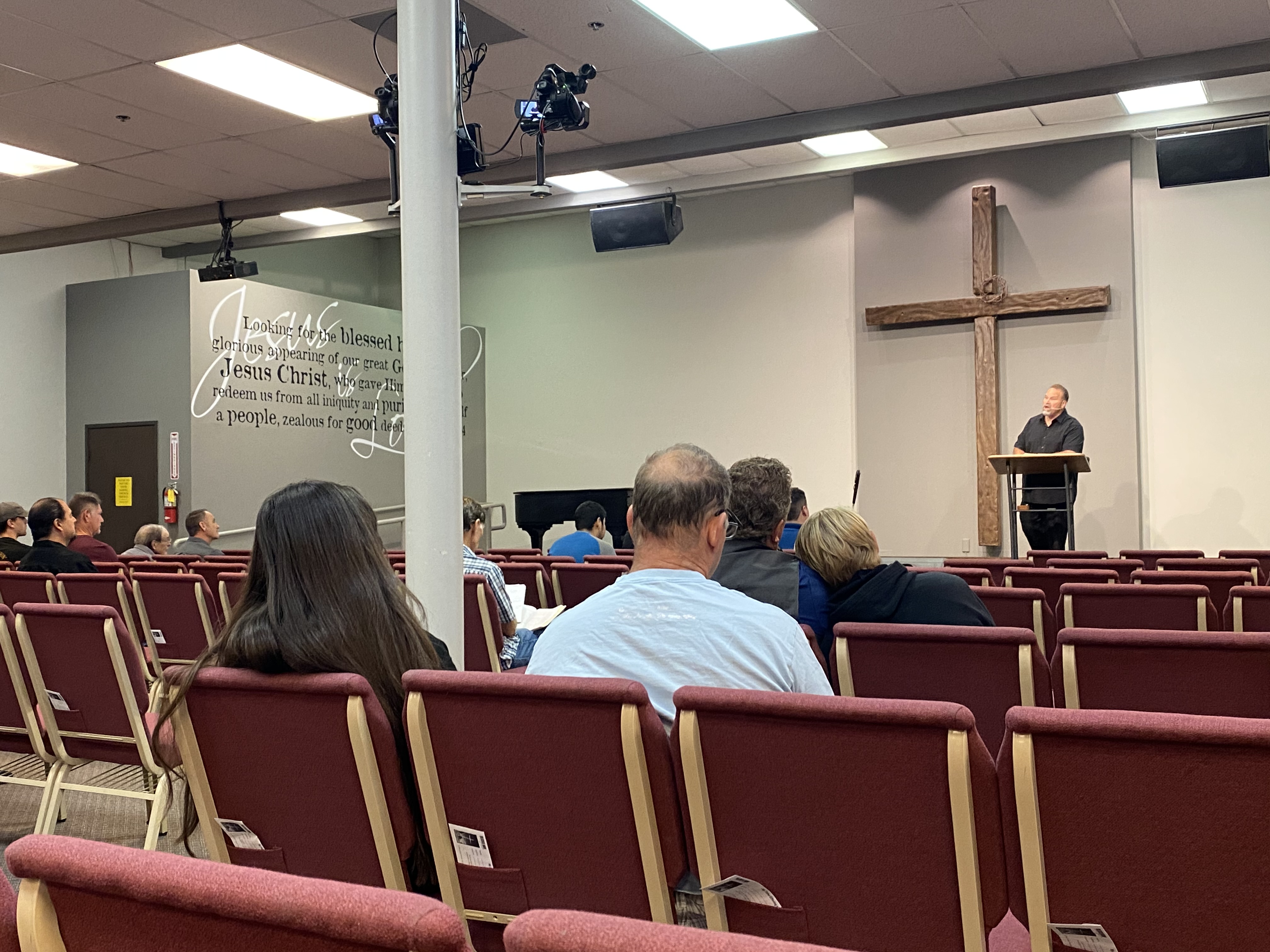
From the back of the sanctuary — Jacob’s vantage point as a security volunteer gave him a view of the congregation that most members never had.
From the Back Row: When Observed Affection Became Unmistakable Boundary-Crossing
Those who heard Jacob describe his role recall him putting it simply: “I was always in the back… I’m always looking, you know, watching over the people in the fellowship… I’m always watching.”
Over time, he noticed Holly Davidson and the young man together frequently. Through the lens most of the congregation had been encouraged to adopt — one of trust, charity, and family-like closeness — he initially interpreted what he saw as benign. Those who heard him describe his observations recall him noting:
They appeared like a tight-knit little family unit.
Holly's affection toward Daniel looked warm, perhaps motherly, especially in a ministry setting where spiritual mentoring was emphasized.
But when the allegations surfaced, when accounts from those familiar with the situation reached him through trusted conversations outside official channels, and when he heard the public and private defenses from Holly and leadership — that “nothing was going on,” that Holly was “completely innocent and sinless” — a sharp collision occurred between memory and narrative. Those who heard his account say he expressed it this way:
“Now, in retrospect, it’s like they’re trying to say, ‘Oh yeah, no, there was nothing going on.’ It’s like, No, I saw different… they’re trying to maintain that Holly was completely innocent and sinless… and it’s like, yeah, I saw differently, so I don’t agree with that.”
Holly is eleven years older than the young man at the center of this account. She is married to Pastor Chad Davidson. From Jacob’s perspective, Chad — whose pastoral role carried biblical responsibility for oversight of both his household and the youth under his care — appeared either unaware or unconcerned about the dynamic unfolding in plain view.
When the Documents Confirmed the Pattern: Jacob's Review of Holly's Letter
Those familiar with Jacob’s account say he did not stop at impressions or the accounts of others. As more information circulated among former members, word reached him of primary written sources, and he sought them out.
According to those who know him, he eventually reviewed:
Letters from the young man at the center of the account to leadership, laying out in detail what had occurred and requesting biblical evaluation and accountability.
Response letters from Chad and Holly Davidson, which often reframed the concerns, minimized the conduct, or redirected focus.
Holly's own letter, which Jacob and Debbie both reviewed and found clearly incriminating — containing admissions by Holly, descriptions of entanglement, and a tone of self-justification rather than repentance.
As those who heard his account recall him putting it: “In talking with other people, it’s a pattern. It’s been years, and we were completely unaware of it.”
"Imagine Going to Court Where the Judge Is the Defendant's Dad"
Once Jacob started connecting the dots, he realized the dysfunction was not only moral; it was structural.
In a two-and-a-half-page letter delivered to leadership, he used a courtroom analogy to describe the authoritarian, unsafe setup at Blessed Hope:
Imagine you had to take someone to court, and the judge was their father, the lawyer was their mother, your attorney worked for the judge, and half the jury worked for the judge. Could any reasonable person say that justice would be done in that courtroom?
This is how he saw the church’s leadership structure:
Joe functioned as the final authority — the "pastor-led" reality underneath the "elder-led" language.
Elders and close family members formed a closed circle of power.
There was no independent oversight, no neutral body to evaluate cases like the one that had prompted the departures.
Former members who knew Jacob recall him concluding: “They need to fix the leadership or it’s going to continue to destroy the church.”
Pulpit Bullying, Silence, and Conscience: Jacob's Path to Departure
Jacob was at the 2025 men’s retreat where Pastor Joe Schimmel told a story that never once mentioned Chad’s wife Holly or the allegations of her conduct toward those under her care, and used the gathered men — and the spiritual authority of that setting — to cement a narrative that Jacob already suspected was not the truth. It painted a Texas family who left the church for other reasons when later he realized the truth was that they left for the very same reasons that he and his wife and others would decide to leave.
Former members who heard Jacob reflect on what he witnessed recall him describing it as “pulpit bullying” — the use of sermons, retreats, and teaching moments not primarily to proclaim the Word faithfully, but to pre-emptively discredit individuals who had raised questions or left due to the elders’ refusal to permit an independent, third-party investigation into the allegations against Holly; to shape the congregation’s perception of the conflict without allowing both sides to be heard; and to portray leadership as righteous, long-suffering victims while framing those who departed as unstable, divisive, deceived, or lacking in grace.
He wrote a careful, reasoned letter to the elders in which he laid out his concerns about the Holly Davidson situation based on correspondence and eyewitness accounts, highlighted the unjust structure of authority that allowed leadership to avoid external scrutiny, and called them to repentance for manipulating truth, refusing accountability, and handling cases in ways that prioritized optics over biblical justice.
According to those who heard his account, the letter went unanswered. As those who spoke with him recall: “It was crickets… which told me a lot.”
Eventually, Jacob’s conflict wasn’t merely about structures, stories, or even silence. It was about conscience before God. He heard sermons proclaiming integrity, walking worthy of the Lord, and doing what is right no matter the cost. Yet behind those messages, he had watched the situation involving Holly reframed and minimized, families who left being misrepresented from a microphone they were not allowed to share, remaining members being told to shun former members, and structural corruption ignored when lovingly pointed out in writing.
Former members who heard Jacob explain his departure recall him saying he could not, in good conscience, sit under this teaching that’s speaking of integrity and doing what’s right and walking in a worthy manner while the opposite is happening in the background.
Contradictory Letters: From Acknowledged Failures to Complete Denial
As former members began comparing written communications related to the internal investigation, one of the most serious concerns emerged: blatant contradictions between statements made by Pastor Jonathan Ball and later claims by Lisa Schimmel on behalf of church leadership. These inconsistencies weren’t mere slips or oversights — they revealed a troubling pattern where the truth appeared to shift depending on the audience.
Pastor Jonathan Ball’s Letter — May 13, 2025
Acknowledged failures and boundary violations
"I invested so many hours investigating…"
Thorough process acknowledged
"Chad had already asked for forgiveness for his failures."
Admitted Chad's failures
"Holly has wept and stated her failures."
Acknowledged Holly's failures
"This is evidence that… she did fail in having good boundaries with you."
Explicit boundary violation
Lisa Schimmel’s Later Letter
Complete reversal — all blame placed on Daniel
"After conducting a careful and impartial investigation, Pastor Jonathan concluded that Daniel alone was guilty."
Contradicts Ball's own letter
"Holly had not sinned."
Direct contradiction of Ball's findings
"Chad had not sinned."
Direct contradiction of Ball's findings
"Daniel alone had done wrong."
Complete inversion of the evidence
May 13, 2025 — The Same Day
Pastor Jonathan Ball’s letter — dated May 13, 2025 — confirms in writing that Holly “failed in having good boundaries” and that Chad “asked for forgiveness for his failures.”
According to witnesses, on that same day — May 13, 2025 — Pastor Joe Schimmel allegedly left a voicemail stating “we have a case of sexual assault” and calling him a predator in a text message to another member of the church.
“There are six things that the Lord hates, seven that are an abomination to him: … a lying tongue, … a false witness who breathes out lies…”
Proverbs 6:16–19
When spiritual leaders appear to contradict themselves in writing — admitting failures in one context while denying them in another — it suggests a willful disregard for truth that God finds detestable, inviting divine judgment on those who persist in such deception.
Different Accounts Given to Different People
Former members report this was not an isolated discrepancy but part of a broader strategy of compartmentalized storytelling. Some were privately told the situation involved mutual mistakes or leadership shortcomings. Others were told Daniel alone bore responsibility. Some heard the matter was resolved; others that it was still under review.
When these varying private explanations were shared among concerned members, the inconsistencies became undeniable — and indefensible. The organization, caught saying two things at once, showed little interest in reconciling the discrepancies or correcting the record, further fueling distrust. For many, the focus shifted: the primary issue was no longer solely Holly’s conduct toward those under her influence, but whether leadership was communicating the same truth to everyone — or deliberately tailoring the story to different audiences to maintain control and avoid scrutiny.
Internal Investigation — But No Outside Review
Blessed Hope Chapel leadership has consistently maintained that the matter was thoroughly investigated and addressed internally by the elders — yet this rings hollow given the evident contradictions in their own documentation.
The Internal Circle — Structural Conflict of Interest
Pastor Joe Schimmel (Holly's father)
Chad Davidson (Holly's husband)
Lisa Schimmel (Holly's mother)
Pastor Jonathan Ball — conducted the internal investigation yet lacked the courage to challenge Pastor Joe's conclusions.
Pastor Steve Aguilar — repeatedly received concerns from an overwhelming number of members and failed to act. According to a person with direct knowledge, Aguilar has allegedly described his own role as being in charge of "damage control" for the church — suggesting his non-response was not pastoral neglect but institutional function.
Elder John Heeber — part of the inner circle that deferred to Pastor Joe rather than pursue independent accountability.
Other elders with longstanding ties to the Schimmel/Davidson family and ministry.
Multiple members repeatedly requested an independent, third-party review — someone without familial or professional entanglements — to examine the evidence impartially. According to witnesses, this request was made more than once and was explicitly for transparency and biblical fairness, not vengeance. Yet the request was refused, time and again, demonstrating a cavalier attitude toward true accountability.
“Lying lips are an abomination to the Lord, but those who act faithfully are his delight.”
Proverbs 12:22
The Predator Accusation: Joe's Claim vs. Holly's Reported Denial
According to witnesses, on May 13, 2025 — the same day Pastor Jonathan Ball wrote his letter confirming Holly’s “boundary failures” with Daniel — Pastor Joe Schimmel left a voicemail in which he allegedly stated “we have a case of sexual assault” — accusing the young man at the center of the allegations; separately referred to him as a “predator” via text to another family who would later also leave the church.
Strikingly, despite this internal declaration of sexual assault, no police report is known to have been filed by church leadership. In California, clergy are mandated reporters under Penal Code §11165.7. Announcing a sexual assault allegation to church families — while making no contact with law enforcement — raises serious questions about the church’s legal and moral obligations.
Despite Pastor Joe Schimmel allegedly declaring “we have a case of sexual assault” in a voicemail and privately branding the young man a “predator” via text, no police report is known to have been filed by church leadership at any point.
Under California Penal Code §11165.7, clergy who know of or reasonably suspect child or adult sexual abuse are mandated reporters — legally required to notify law enforcement or child protective services. Announcing a sexual assault allegation internally to church families, while making no known contact with authorities, raises serious questions about whether the church fulfilled its legal obligations — and whether the allegation itself was ever meant to be substantiated or simply weaponized.
The Berean Examiner found no record of any law enforcement contact, report, or referral connected to this allegation.
When two church members later directly asked Holly whether an assault had occurred, she reportedly answered “No.”
Reported Contradiction — Core Inconsistency
Pastor Joe’s Alleged Voicemail & Text — May 13, 2025
Allegedly stated “we have a case of sexual assault” in a voicemail — accusing the young man at the center of the allegations; separately referred to him as a “predator” via text to another family who would later also leave the church. No police report is known to have been filed.
Holly’s Reported Direct Response
When two church members directly asked Holly whether an assault had occurred, she reportedly answered “No.”
Two Possibilities. Neither One Is Acceptable.
This is not a matter of differing perspectives or competing interpretations. When a senior pastor repeatedly tells church members — by voicemail, by text, and verbally — that “we have a case of sexual assault,” the claim is either true or it is not. The evidence assembled in this investigation, including Holly’s own letter, her direct verbal denial, the testimony of multiple witnesses, and the absence of any police report, compels a binary question that leadership has never been forced to answer:
If pastor Joe’s Claim Is True
If the sexual assault allegation is true, then:
Why did Holly answer "No" when two church members directly asked her whether an assault had occurred?
Why does Holly's own written letter describe her "boundary failures" toward Daniel — the language of a person who crossed lines, not a victim recounting an assault?
Why was no police report ever filed? California law (Penal Code §11165.7) mandates clergy report known or suspected sexual abuse to law enforcement.
Why did Pastor Jonathan Ball's letter — written the same day as the voicemail — frame the matter as Holly's boundary failures and Chad's need for forgiveness, with no mention of assault?
Why has leadership refused every request for an independent investigation, if the facts unambiguously support their version?
If true — why does every piece of evidence point the other direction?
If pastor Joe’s Claim Is False
If the sexual assault claim is fabricated or unfounded, then:
A pastor used his authority to spread a false sexual assault accusation against a young man — by voicemail, by text, and verbally — to multiple church families.
That false accusation was used to reframe Daniel as the predator, neutralizing his credibility at the exact moment families were beginning to question Holly's conduct.
The "predator" label was not a conclusion drawn from evidence. It was a weapon deployed to protect a family member.
Spreading a knowingly false sexual assault accusation to third parties constitutes defamation per se — among the most serious categories of civil harm.
Holly's own "No" — her direct denial of the assault her father was alleging — means that if this claim is false, she is either unaware her father was making it, or the two accounts have never been reconciled.
If false — a pastor weaponized a sexual assault claim against an innocent person.
Pastor Joe Schimmel and Holly Davidson cannot both be telling the truth.
Her letter. Her denial. His voicemail. His texts. His words to families. These are not compatible accounts from people with access to the same facts. One of them is false — and the evidence assembled in this investigation, combined with the church’s persistent refusal of an independent review, makes clear which direction that points.
This incident fits a broader pattern reported by multiple former members: when individuals raise legitimate concerns about Holly’s alleged indiscretions, church finances, or questionable activities at women’s retreats, leadership has frequently responded by attacking the character of the person bringing the concern rather than addressing the substance of the issue. Instead of investigating or taking the complaints seriously, the focus has allegedly been shifted back onto the critic, portraying them as the problem.
Such tactics of deflection and character assassination, according to witnesses, continue to erode trust and demonstrate a leadership culture more focused on protecting its image than on biblical integrity and transparency.
The 2025 Men's Retreat: Narrative Deflection and Character Assassination Under Spiritual Cover
In May 2025, Pastor Joe Schimmel convened Blessed Hope Chapel’s annual men’s retreat — billed as a time of biblical teaching on manhood and spiritual warfare. According to multiple attendees, it became something else: a sustained, unilateral account of why a particular family had ended its affiliation with the ministry. The family’s actual reasons for leaving were never mentioned. What those reasons were — and why they had been omitted — would only become clear to most men in that room months later, as additional families departed for the same documented causes.
Former members with direct knowledge of conversations during that period report that former elder John Heeber had privately conveyed, to those in the circle connected to the departing fellowship, that he was aware of alleged sexual misconduct so “explosive” it would force the church to restructure itself and require proper oversight of the elder board. Yet John failed to act or stand with those calling for accountability against the pressure from Pastor Joe and Pastor Chad. As the real reasons behind the departure gradually became understood within that home-church fellowship — through conversations among people who had witnessed the same patterns firsthand — the community began to form its own picture of what had occurred. Some in that circle believed what they were hearing and understood why the affiliation had ended; others went directly to Pastor Joe Schimmel for an explanation and ultimately accepted the leadership’s version without further questioning.
Two men from the Texas group, Joe Bokaie and Brian Stegall, collaborated with Pastor Joe during the retreat session that reframed the narrative away from Holly. According to multiple men who attended, the session left them genuinely confused — numerous men present did not understand why more than 1.5 hours had been dedicated to a sustained negative portrayal of a family that had simply chosen to end its affiliation with Blessed Hope Chapel. Many left the session troubled and disagreed with the way the matter had been handled, but without enough context to fully articulate why. It was only later — after many more families left for the same documented reasons, and word spread across the former-member community about what had actually occurred with Holly — that the retreat session finally made sense to those who had been in the room.
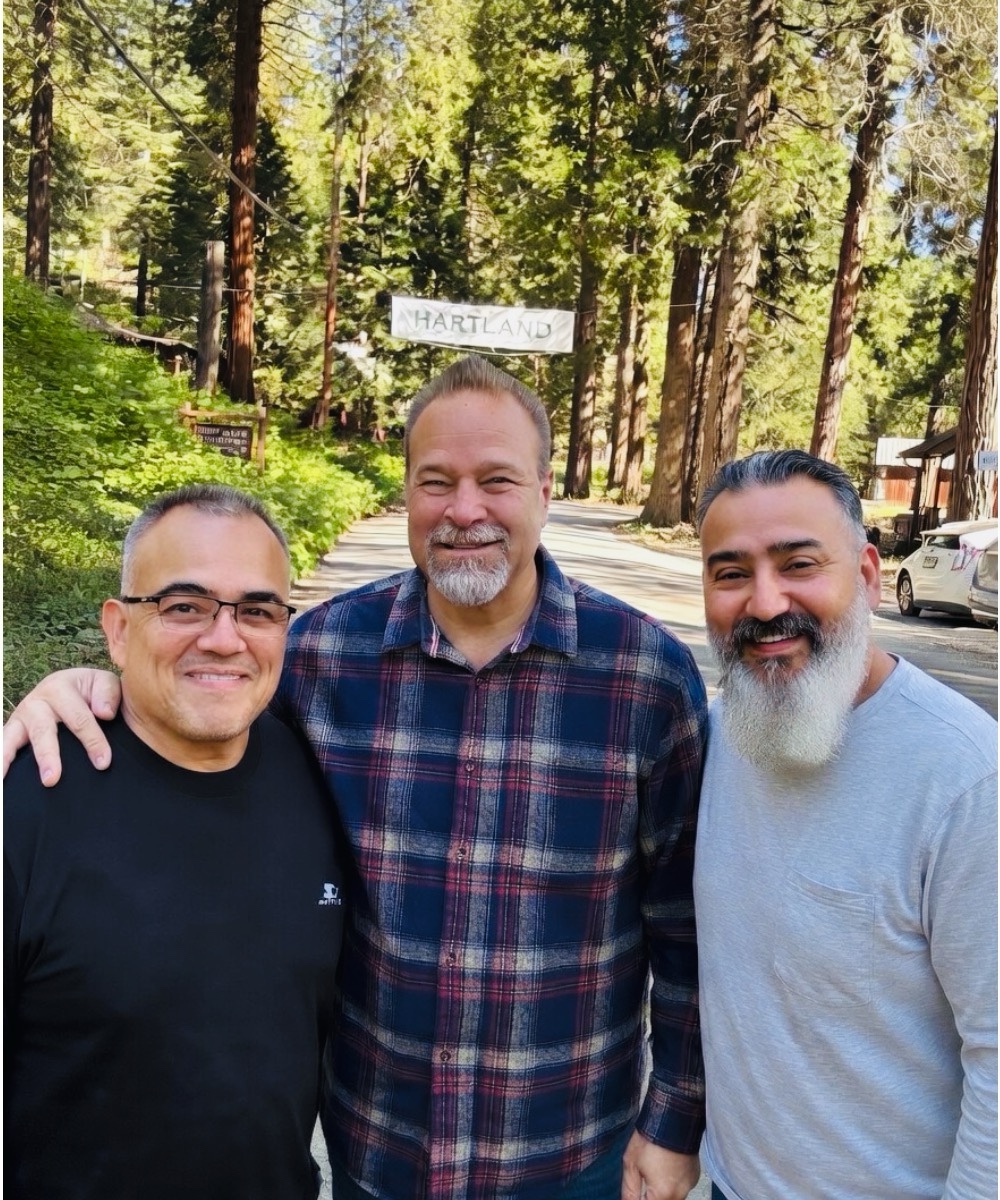
Brian Stegall, Pastor Joe Schimmel, and Joe Bokaie — who aligned with BHC’s narrative over calls for a third-party investigation.
At the retreat itself, Pastor Joe Schimmel reportedly shared a story that never once mentioned Holly or the specific underlying allegations. Instead, he presented an alternative explanation for why this family had parted ways with the ministry — portraying them as unstable, divisive, or spiritually immature. Key facts known to the family and witnesses were omitted entirely; the narrative was reshaped to exonerate leadership and cast the departing members in a negative light.
No opportunity was given for the family to respond, correct the record, or clarify their actual reasons for leaving; they were neither present nor permitted any voice in how their departure was portrayed. According to witnesses, the session was recorded and later shared widely by Pastor Joe’s longtime associate Tony Palacio, who remains active with Good Fight Ministries and Blessed Hope Chapel. The recording circulated among attendees who disagreed with how the session was handled — men who left troubled and confused — and through those channels eventually reached communities connected to those who had left.
By December 2025, in a recent online sermon, Pastor Joe Schimmel announced that the Texas livestream group may be getting a new pastor — referring to Joe Bokaie, who allegedly sided with Pastor Joe’s narrative in May 2025 and did not scrutinize his account of events. Some speculate this could have been the pattern all along: keep those close to you who easily agree and place them in positions that ensure continued loyalty to the Blessed Hope Chapel elder board.
Former members characterize this as authoritarian deflection disguised as spiritual guidance — a calculated misuse of the pulpit and retreat platform to:
Shield a family member (Holly) from scrutiny by never addressing the core allegations,
Defame those who left due to legitimate concerns,
Redirect attention away from leadership accountability toward the supposed failings of the departed.
Witnesses who spoke with other former Simi Valley congregants described it as a deliberate move to “cement” a false narrative in the men’s minds, exploiting the retreat’s spiritual atmosphere — prayer, teaching, and fellowship — to preempt doubt and shield Holly from scrutiny.
Such tactics echo the broader patterns observed at Blessed Hope Chapel: narrative control, selective omission, and the inversion of victim and perpetrator roles. Scripture warns against shepherds who scatter rather than gather the flock (Ezekiel 34:4–5), who “lord it over” those entrusted to them (1 Peter 5:3), or who use words to sow discord rather than build up (Proverbs 6:16–19). When a retreat meant for edification becomes a vehicle for character assassination and truth suppression, it raises serious questions about whether the ministry is functioning as a New Testament body under Christ’s headship or as a system that prioritizes institutional protection over biblical integrity.
This incident, corroborated by multiple witnesses who knew the Texas family and later connected with other departing congregants, contributed significantly to the growing realization among former members that internal appeals for transparency — including repeated requests for an independent investigation — would not be met with humility or reform, but with deflection and silence.
Coerced Affidavit: Pressure on an Elderly Congregant
The elderly congregant’s account stands entirely apart from the specific allegations described elsewhere in this investigation. He was not a witness to the conduct at the center of the Holly Davidson situation, nor was he closely connected to the families whose departures are documented in these pages. What he witnessed was something else entirely — what happens inside a leadership structure when it decides that a particular person needs to be useful to its narrative, regardless of whether that person genuinely agrees with the conclusion he is being asked to endorse.
One of the most disturbing details to emerge from the months leading up to the December 8 meeting involves this elderly former congregant — well over 80 years old — who stated that he was pressured by Pastor Joe Schimmel and the elders to sign an affidavit declaring that he fully agreed with Pastor Joe’s version of events regarding Holly Davidson’s conduct and the circumstances that had led to the departures.
According to witnesses, the man later confided to other church members that he did not actually agree with what he had signed. He also reported that he was never given a copy of the signed document.
This account raises serious concerns about the tactics allegedly used by leadership to manufacture support and silence dissent. Pressuring an elderly member to sign a statement he did not truly believe, and then withholding that document from the very people who signed it, contradicts basic principles of honesty, consent, and pastoral care. It also mirrors the broader pattern documented throughout this investigation: controlling the narrative by any means necessary, including leveraging the trust of those least positioned to push back.
What Witnesses Report:
An elderly congregant (80+) was pressured by Pastor Joe Schimmel and the elders to sign an affidavit affirming their version of events.
The man privately told other members he did not agree with what he had signed.
He was not given a copy of the affidavit he signed.
“You shall not oppress your neighbor or rob him… You shall do no injustice in court.”
Leviticus 19:13, 15
When spiritual leaders exert pressure on vulnerable members — especially the elderly — to sign statements they do not truly believe, and then withhold those documents from the very people who signed them, it reveals a leadership culture more concerned with controlling the narrative than with truth or compassion. It is not the conduct of shepherds. It is the conduct of institutions protecting themselves.
The Mass Exodus Was Tied to the Same Core Concerns
By December 2025 letters, texts and emails made clear that while each family’s experience had its own details, the underlying concern was the same.
According to the correspondence, people left because of:
Serious moral concerns involving church leadership and staff.
Inconsistent explanations from leadership.
Refusal of a true independent investigation.
Concealment or narrative control.
Public criticism of those who left.
The growing belief that the church was protecting insiders instead of examining the facts honestly.
Why the Number Matters
For those who left, the list in the December 2025 letter was not included to create pressure or build a faction. It was included to show that the concern was broad, shared, and rooted in actual experience. The number mattered because it directly contradicted any suggestion that this was merely the grievance of one unhappy person.
More than fifty people did not leave because of one rumor.
According to the former members who signed or supported the letter, they left because they believed serious misconduct allegations had not been dealt with honestly; they believed the investigation was compromised by family ties and internal handling; they believed leadership gave inconsistent answers; and they believed the church refused the one step that could have restored trust: a true third-party investigation.
50+
People — families, staff, volunteers, hosts, witnesses, parents, longtime members — walked away.
All citing the same documented pattern.
Casualties of the Scandal — Friendships and Families Divided
As the controversy surrounding the allegations, the internal investigation, and the refusal of an independent review continued, former members say the damage did not stop with people leaving the church.
According to multiple witnesses, the conflict began to divide friendships, strain families, and separate people who had once served closely together in ministry. They said the longer the situation went unresolved, the more the church community began to split along lines of who trusted the leadership’s explanation and who believed the matter had not been handled honestly.
One example repeatedly mentioned by former members involved the severed friendship between a central figure in this account and a ministry contact connected to the fellowship in Mexico — someone tied to the broader circle around Pastor Jonathan Ball. After the dispute over the investigation’s conclusions, communication between the two reportedly became strained. According to witnesses familiar with how events unfolded, word circulated among those close to the situation that the friend had been advised to keep distance, and that continued contact could create problems within the ministry circle connected to Blessed Hope and the Mexico fellowship.
Witnesses also described tension inside families connected to the church after the investigation. According to former members familiar with those circles, people with close personal ties to those involved reportedly tried to speak with leadership — including Pastor Jonathan Ball — and came away saying they were unable to have the kind of conversation they had hoped for.
The division was not limited to people on the outside of the leadership circle. According to the December 2025 letter listing those who had left, the departures included volunteer staff who were part of Pastor Joe Schimmel’s extended family — showing that the controversy was not only affecting newer members or distant families, but people who had close personal and family ties to the church’s leadership.
Several said the church no longer felt like a place where questions could be asked freely without risking damage to relationships. For those who left, they say the pattern was unmistakable. Former congregants said the situation began to feel “cult-like,” not because of doctrine, but because relationships seemed to depend on whether a person accepted the leadership’s explanation without question.
The Abundant Life Youth Retreat — Big Bear Lake, June 2024: A Pattern That Followed Them Into the Mountains
(The families, youth, and individuals referenced in this section are not identified by name. Their accounts reached this publication through former members and people who spoke with those involved after the event. This publication did not speak with participants directly. Pseudonyms are not used here to prevent any inadvertent identification; all identifying details are withheld.)
This section documents an incident entirely independent of the situation described earlier in this investigation. It involves different youth, different families, a different event, and entirely different harms. It is included here because it reflects the same documented pattern of leadership conduct — not because it corroborates the same incident. The families whose children attended this retreat had their own separate encounter with the same system.
From June 10 to 14, 2024, a youth retreat billed as the Abundant Life Youth Retreat was held at Big Bear Lake Christian Camp in Big Bear Lake, California. The event was not organized under the banner of Blessed Hope Chapel — it was hosted by Holly and Chad Davidson through Good Fight Ministries. Families from across the country were invited to send their children, ages 14 to 19, to spend several days in the mountains in a setting designed, at least on its face, to deepen their faith.
According to accounts relayed through former members familiar with what occurred, the retreat initially appeared well-organized. Families who had trusted Chad and Holly’s ministry reputations sent their children with reasonable confidence. What unfolded over the following days, however, reflected a pattern that anyone who had watched Chad’s conduct over the preceding years would have recognized immediately: the wrestling program moved in, and the ministry focus moved out.
What the Retreat Was Supposed to Be
A Christian youth retreat for ages 14–19, hosted through Good Fight Ministries
Focused on spiritual growth in a retreat setting — Big Bear Lake Christian Camp
Open to Christian families across the country, many of whom trusted Chad and Holly's ministry credibility
Billed as a spiritually intentional environment for young people at a formative stage of their faith
Former members familiar with the situation describe what actually occurred as an almost immediate unraveling. According to those who heard accounts from families and youth who attended, Chad arrived at the camp with non-believing wrestlers from his program — the same pattern documented throughout this investigation, in which young men from his athletic world were routinely brought into ministry spaces without the spiritual discernment or boundaries appropriate for those settings. In a retreat explicitly designed for the delicate spiritual formation of young Christians, the presence of non-believing wrestlers introduced exactly the kind of distraction, disruption, and misaligned energy that no attentive pastor would permit.
Those familiar with the event say the youth found the retreat disjointed and chaotic. Multiple young people who later described what occurred — as recalled by former members who heard their accounts — reported that Chad spent the majority of his time with the wrestlers, leaving the remaining staff without adequate direction or support. For families who had sent their children across the country for a focused spiritual experience, what they received back was a report of a poorly supervised environment where the ministry purpose of the event had effectively been displaced.
"Someone Had to Step In": The Near-Incident at Night and the Woman Who Kept It From Getting Worse
The situation reached its most alarming point when a young male was discovered in the process of leading a young girl away from the group and off alone at night. According to accounts relayed through former members who heard from families involved, it was not any adult leader who caught the situation in time — it was another youth at the camp who noticed what was happening and acted.
That youth contacted their parents, who in turn reached out to a family from Simi Valley connected to the ministry. That family’s spouse — who was present at the camp — was alerted and moved to intervene. According to multiple former members familiar with how events unfolded, it was her quick action and presence of mind that prevented what could have been a far more serious outcome. The youth at the camp reportedly could not say enough about her willingness to step in and fill the gaps that Chad and Holly had left — a role, former members note with some bitterness, that should never have fallen to a single parent volunteer at a ministry-organized event. This family and the individual involved are not identified here by name; their story reached this publication through people who knew them and were familiar with what they reported after the camp.
As former members who heard the accounts recall it being described: if it hadn’t been for a parent volunteer, the camp would have gone much worse.
This is not a minor administrative failure. A young male — introduced into a Christian youth retreat by the hosting pastor himself — was in the process of leading a teenage girl off alone at night before anyone in a leadership position had noticed or intervened. The chain of intervention that prevented a worse outcome ran through a youth, then a parent, then a phone call to another city, and then to a parent volunteer on the ground willing to help. Not through any of the designated leaders of the event. The pattern of misplaced priorities — Chad with the wrestlers while the spiritual and physical safety of the youth he was responsible for went without adequate oversight — is documented here not as an isolated moment but as a visible expression of what former members had been observing for years.
The Aftermath: A Young Girl Pursued, a Family in Crisis, and Leadership That Blamed the Mother
The consequences of the camp’s failures did not end when the retreat did. According to accounts relayed through multiple former members who were made aware of what followed, one of the young girls who attended the retreat was subsequently pursued by one of the wrestlers (a nonbeliever) after the camp ended. She was too young to be in that kind of relationship, and the attention she received — from a young man introduced into her world through what was supposed to be a Christian ministry event — created serious personal and relational difficulties for her in the weeks and months that followed.
Rather than emerging from the Abundant Life Youth Retreat with her faith strengthened — which was the stated purpose of the event — she reportedly went through a difficult period that left her struggling. Former members who are familiar with what the family experienced say she did not come out stronger. Multiple people with knowledge of the family’s situation reportedly conveyed that her daughter nearly ran away from home during this time. This account was relayed through people who were familiar with what the family shared; this publication did not speak with the family directly, and all identifying details are withheld.
The mother, according to those who spoke with people familiar with her account, sought help from Chad and Holly. What she received — at least according to those who later spoke with her — was not pastoral care, practical support, or any acknowledgment that the environment their event had created bore any responsibility for what her daughter had experienced. Instead, the situation was reportedly reframed as her problem. Those who are familiar with the account describe the response as consistent with what former members had seen in every other instance: the blame was redirected away from leadership and placed on the family that was already suffering.
The Pattern — Documented Across Multiple Incidents
Non-believing wrestlers introduced into a ministry space — same as wrestling events at BHC, same as the original dynamic with Daniel.
Oversight failures during the event — Chad focused on the wrestlers while the youth he was responsible for went without adequate supervision.
A near-incident involving a young girl that was only prevented by the initiative of another youth and a parent volunteer.
A young girl left worse off spiritually and relationally as a direct result of the environment the event created.
A mother who sought help from leadership and was told, in effect, that the problem was hers to bear.
Joe Schimmel and the Blessed Hope Chapel elders — aware of the event and its leadership — took no known corrective action.
The Abundant Life Youth Retreat has received no public acknowledgment from Good Fight Ministries or Blessed Hope Chapel leadership. No apology to the families whose children attended. No explanation for why non-believing wrestlers were included in a retreat designed for Christian youth in a spiritually sensitive setting. No response to the family of the girl whose experience in the aftermath of the camp was reportedly so difficult that it brought her household to a breaking point. And no corrective action of any kind, according to former members with knowledge of what was reported to leadership.
For those who had watched Chad co-opt wrestling into every dimension of his ministry — first the church’s youth program, then the Costa Rica outreach, then the social fabric of Blessed Hope — the Big Bear retreat was not a surprise. It was a confirmation. The same person who had introduced a young man with no spiritual grounding into the life of Blessed Hope Chapel’s youth, who had failed to supervise a dynamic that everyone except leadership appeared to see clearly, had been given the keys to a retreat specifically designed for the most spiritually vulnerable age group in the church’s orbit. The result was predictable to anyone who had been paying attention. And predictably, when it went wrong, it was someone else’s problem to fix — and someone else’s fault.
Recent Conduct That Renewed Concerns
Former members say the controversy surrounding Holly Davidson did not remain confined to the past. In recent weeks, new concerns were raised after witnesses observed behavior that they believed reflected the same pattern that had led to the original allegations years earlier.
According to multiple people who attended a recent wedding connected to the church community, Holly’s conduct at the event drew attention because of what they described as unusually familiar interaction with young men who were present, including wrestlers connected to the same athletic circle where Daniel had first met Chad and Holly years earlier.
Several attendees said Holly was seen spending extended time in close proximity to young men at the event, including standing very close, posing for pictures, and interacting in ways that some observers felt were overly familiar for a married woman whose husband serves as a pastor.
Another detail that witnesses said troubled them was the way Holly was dressed at the event. According to those present, she wore a dress that some described as low-cut and revealing, with a slit that exposed much of her leg. Several said the outfit drew attention because it appeared out of place for someone in a position of spiritual leadership, especially at a gathering where many young men connected to the church and wrestling program were present.
Witnesses also noted that Chad Davidson was present at the wedding and did not appear to object to the interaction or the way Holly was conducting herself. For some former members, this detail was significant because earlier testimony had described Chad as failing to intervene when boundaries between Holly and Daniel became too close in the past.
Several former members said the event confirmed for them why they had insisted that the situation involving Holly Davidson needed to be examined by someone outside the leadership structure.
Why an Independent Investigation Is Still Being Requested
After years of letters, meetings, testimony, and departures, former members say the central issue has never changed. From the beginning of the controversy surrounding Holly Davidson, the request has been the same: that the situation be examined by a truly independent, outside party rather than handled only within the same leadership circle connected to the people involved.
Former members say their goal is not to prove one person right and another wrong, but to determine what actually happened. Some former members have said openly that if an outside review concluded that the accusations were exaggerated, they would accept that outcome. Others say they believe the evidence will show that serious mistakes were made.
They argue that refusing an independent investigation only deepens suspicion, because it makes it appear that leadership is more concerned with protecting itself than with examining the facts.
If nothing was done wrong, why not allow an independent investigation?
Former members say that question has never been answered in a way that satisfies the written record, the testimony of witnesses, and the number of people who felt compelled to leave.
Because the case involved the senior pastor’s daughter, an elder’s wife, and decisions made inside the same leadership circle, former members say the situation created the appearance of partiality — whether intentional or not. They argue that an independent investigation is the only way to remove that appearance and allow the facts to stand on their own.
Late-Breaking: Additional Sources Surface Financial Oversight Failures and an Uncertain Future
Editor’s Note — Received After Initial Publication
Following the publication of our initial investigation, The Berean Examiner received additional communications from multiple independent sources with direct knowledge of Blessed Hope Chapel’s internal operations. These accounts corroborate earlier testimony and introduce new concerns regarding financial governance, property handling, and the church’s institutional future.
One tipster who described attending Blessed Hope Chapel for many years wrote plainly: “It’s a very small church that never grew in the years we were there. I always saw red flags.” Among the most striking details offered was the complete absence of financial accountability to the congregation:
“In the many years we were there, we never once saw a yearly financial report of where the money was going. Not at church, not online, and never spoken about. The pastor is head of the church. His wife does the finances. His son-in-law is an elder.”
This structural arrangement — where the senior pastor, his wife, and his son-in-law collectively govern the ministry’s teaching, finances, and elder board — mirrors the exact conflict-of-interest model Jacob described in his courtroom analogy earlier in this report. Multiple sources now confirm that this arrangement extended to the church’s finances in ways that went unchallenged for decades.
"Good Fight Can No Longer Stay Rent-Free": The Building Crisis and What It Reveals
A recent tipster, describing themselves as a former attendee who is “glad to no longer be a part” of Blessed Hope Chapel, offered a pointed summary of the ministry’s current institutional trajectory:
“Many congregants have gone to Pastor Joe and the elders about numerous grave concerns only to be turned away. Their intermingling of Good Fight can no longer be in the Blessed Hope property rent free if indeed that was the arrangement.”
This is a significant detail: according to this source, Good Fight Ministries — the apologetics and media organization led by Pastor Joe Schimmel that operates alongside the church — has allegedly been occupying space on the Blessed Hope Chapel property without paying rent. As membership has collapsed and financial realities shift, that arrangement may no longer be sustainable.
The tipster also gave voice to what many observers have noted as a painful irony at the center of this story:
“It’s ironic that they constantly want to expose evil in other churches when they have gone without oversight for thirty years. Dangerous situation which we are glad to no longer be a part of.”
Good Fight Ministries has spent years producing documentaries, articles, and warnings about corruption in other churches and ministries. That a ministry with such a public-facing accountability mission would itself allegedly operate without financial transparency, without independent oversight, and without a mechanism to address serious moral concerns internally is a contradiction that these sources say has not been lost on those who lived it from the inside.
“They constantly want to expose evil in other churches — when they have gone without oversight for thirty years.”
— Source with direct knowledge of Blessed Hope Chapel operations
Financial Transparency Update: "Books Were Checked" vs. Reported Reality
Late-Breaking — Financial Accountability
In response to earlier Berean Examiner reporting on financial transparency concerns at Good Fight Ministries, new accounts have surfaced that raise direct questions about the integrity of the reassurances offered to congregants.
In response to earlier Berean Examiner reporting, Pastor Joe Schimmel has reportedly told congregants that the books were reviewed by a retired congregant with a background in financial analysis and internal auditing, who supposedly confirmed that everything was fine. According to witnesses, church bookkeeper Mary Drinkhall told at least one concerned congregant that this individual had checked the books and they were “totally good.”
However, a longtime congregant reports a sharply different account. That individual privately stated they never conducted any formal review. According to this source, they only glanced at a few pages, verified the salaries — but didn’t examine expendables such as travel, food, car rentals, hotels, and fund allocations. No written report or substantive findings were produced.
The Contradiction at a Glance:
Public Account
“[A church member] checked the books. They were totally good.” — Reportedly conveyed by bookkeeper Mary Drinkhall to concerned congregants
Private Account
That individual reportedly stated they never conducted a formal review — only glanced at a few pages, verified salaries, and did not examine expendables. No written report was produced.
This outcome is unsurprising given that the individual in question is retired, does not operate an active accounting firm, and holds no current professional certifications in forensic accounting or auditing. Placing the burden of financial assurance on a retired congregant — rather than engaging a credentialed, independent CPA or auditor — is itself a failure of fiduciary responsibility. If true, this informal glance falls far short of any professional standard of financial review — and presenting it to donors and members as meaningful assurance raises potential legal and regulatory concerns.
Legal & Regulatory Context
California Corporations Code § 5231
Nonprofit directors bear a fiduciary duty of care to the organization and its members. Representing a superficial internal review as substantive financial assurance may fall short of that standard.
California Business and Professions Code § 17510 et seq.
California's charitable solicitation laws prohibit misleading statements to donors. Assurances that are inconsistent with the actual level of examination performed risk violating these protections.
California Attorney General's Registry of Charitable Trusts / IRS
Such assurances, when inconsistent with the actual level of examination, could invite scrutiny from the California AG's charitable trust oversight authority or federal tax regulators.
This public reassurance — reportedly delivered through bookkeeper Mary Drinkhall — stands in sharp contrast to the reported private reality of a superficial glance. The discrepancy mirrors the same pattern of contradictory statements and narrative management seen throughout this investigation. A statement is made publicly to calm congregants; the private account tells a different story entirely.
If confirmed, the alleged property transaction — where a donated asset was liquidated and proceeds directed to benefit Pastor Joe, without congregational knowledge or consent — would represent a serious breach of fiduciary duty and the basic stewardship principles Scripture requires of church overseers. The Bible demands that those who handle the Lord’s finances do so “above reproach,” in full view of those they serve (2 Corinthians 8:20–21).
One source summarized it with striking directness: “Zero oversight on the leadership.”
Connected Investigation — Part I
$237,823 in Undisclosed Salaries & an 85% Asset Drop Raise Serious Questions for Good Fight Ministries
The affiliated 501(c) organization — same leadership, same building, zero voluntary financial transparency.
A Pattern Thirty Years in the Making
Taken together, these late-breaking accounts do not merely add isolated data points. They complete a picture that has been forming throughout this entire investigation: a closed authority structure, decades without external review, finances managed opaquely by the pastor’s family, members silenced or rebuked for legitimate questions, and a ministry whose public posture of exposing institutional failure in other churches stands in stark relief against its own internal record.
The cumulative weight of this evidence — spanning pastoral conduct, financial governance, the handling of Daniel’s allegations, and the treatment of those who asked questions — points to a single structural failure: a ministry that has never been held accountable by anyone other than itself.
“The elders who direct the affairs of the church well are worthy of double honor… Do not entertain an accusation against an elder unless it is brought by two or three witnesses. But those elders who are sinning you are to reprove before everyone, so that the others may take warning.”
1 Timothy 5:17–20
"Two or Three Witnesses" — The Standard Church Leaders Often Invoke, and What the Evidence Actually Counts
When confronted with serious allegations, church leaders commonly appeal to 1 Timothy 5:19 — “Do not receive an accusation against an elder unless it is brought by two or three witnesses.” It is a genuine scriptural standard. It is also, in practice, one of the most frequently weaponized verses in institutional self-defense: invoked not to ensure fairness, but to raise a procedural barrier high enough to dismiss any concern before it can be examined.
The verse’s purpose is protection against false accusation — not insulation from documented, multi-source, corroborated evidence. Paul wrote it to Timothy in the context of ensuring accountability could proceed fairly, not to construct an immunity threshold that a closed leadership circle could administer on its own behalf. An elder board that receives accusations, investigates them internally, and then declares its own family members innocent is not applying this verse faithfully. It is using it as a door lock.
So let us apply the standard honestly — and count the witnesses this investigation has documented.
1 Timothy 5:19 — Applied to the Evidence in This Investigation
“Do not receive an accusation against an elder unless it is brought by two or three witnesses.”
Livestream family members (multiple individuals)
Present during the 2021 visit. Multiple people independently observed Holly leaning on Daniel excessively, taking long walks alone with him, and placing his head in her lap. Their accounts are consistent with one another and with other witnesses who had no contact with them.
Jacob — security volunteer and audio/visual technician
Observed the relationship firsthand from the back of the sanctuary over years. After reviewing Holly's letter and additional correspondence, described the conduct as a multi-year pattern he had witnessed but not fully understood until the picture came together.
Debbie — Jacob's wife
Independently reviewed Holly's letter and arrived at the same conclusion as her husband. Their accounts are corroborated by people who heard them describe their observations.
Jane — youth group observer and mentor
Observed the relationship over years from within the youth program. After reading Holly's letter independently, her assessment of who "sounded like the predator" was unambiguous — and was not changed by repeated attempts from leadership to persuade her otherwise.
Ed — Jane's husband
Present for multiple discussions and observations. Participated in the multi-hour leadership meetings where both he and Jane were left, by multiple accounts, deeply disoriented.
Matt and his wife — children's ministry volunteers
Confronted Chad directly before departing in 2024, citing 1 Timothy 3:4–5 and a documented pattern of Chad's own children being out of control in the children's ministry setting. Their account has been widely circulated among former members.
Multiple family witnesses at wrestling events
Families who attended events where Chad coached independently observed Holly's conduct and appearance and discussed it openly. These observations predate and are entirely independent of the specific Daniel allegations.
Costa Rica trip witnesses
Multiple people on or familiar with the trip described Chad's explosive conduct and the social media posts showing Holly in circumstances multiple observers described as inconsistent with ministry leadership.
Approximately 66 men at the May 2025 men's retreat
Present when Pastor Joe delivered a sustained narrative about a departing family without mentioning Holly or any underlying allegations. Many left troubled and confused. Multiple described the session as "pulpit bullying" after the fuller picture became clear.
The elderly congregant pressured to sign an affidavit
Reported to other members that he did not agree with what he had signed and was never given a copy. His account provides direct corroboration of leadership's use of pressure tactics against vulnerable members.
Two church members who directly asked Holly about the assault
Holly reportedly answered "No" when asked directly whether a sexual assault had occurred — directly contradicting Pastor Joe's voicemail claim.
Multiple long-term congregants on financial transparency
Independently confirmed that no financial report was ever shared with the congregation across many years of attendance. Not one annual financial disclosure. Consistent across multiple independent sources.
Families and youth from the Abundant Life Retreat — Big Bear Lake, June 2024
Multiple families from across the country sent their children to a retreat that, by accounts relayed through former members who heard from them, was disorganized, improperly supervised, and produced documented harm to at least one young girl. Their accounts include the near-incident in the woods, the pursuit of a minor by a wrestler following the camp, and the mother's reported experience of being blamed when she sought help from Chad and Holly.
Wedding witnesses (multiple attendees)
Observed Holly's conduct at a recent event attended by young wrestlers connected to the same circles where the original allegations arose. Multiple attendees, independently, described behavior they found inconsistent with pastoral leadership.
Multiple additional sources — financial, structural, and institutional
Former members with direct knowledge of operations confirmed the alleged rent-free Good Fight arrangement, the absence of any legitimate financial review, and the "zero oversight" structural reality described across this investigation.
15+
documented witness groups
The biblical threshold is two or three. This investigation documents fifteen distinct witness groups — most containing multiple individuals — whose accounts are mutually corroborating and independently sourced. This count does not include additional witnesses whose accounts were not incorporated into this article, nor individuals who have not yet come forward. The standard invoked by leadership to dismiss these concerns was met many times over before this investigation began.
The question is not whether the threshold has been met. It has. The question is why the threshold was never honestly applied by the people whose responsibility it was to apply it.
Questions About Elder Jonathan Ball’s Criminal Record and Fitness for Leadership
Public Record — Court Documents
The following section is based on publicly available court records and accounts from sources with direct knowledge of the events described. The criminal record referenced below was independently verified through public court documents.
Public court records confirm that on March 15, 2002, Jonathan Michael Ball — then 20 years old — was arrested in Malibu on multiple charges. He was ultimately convicted on one count of Penal Code 148.9: making a false report of a criminal offense, a misdemeanor. Two additional charges — one under the former Penal Code 12020 related to prohibited weapons, and one under Health & Safety Code 11364 for possession of drug paraphernalia — were dismissed.
The existence of this record has been described by those familiar with the Blessed Hope Chapel leadership circle as an “open secret” — known within the inner circle, never disclosed to the congregation, and apparently no obstacle to Ball’s placement as the head pastor over the church in Ensenada, Mexico.
Public Court Record — Los Angeles County
Date of Arrest
March 15, 2002
Location
Malibu, California
Subject
Jonathan Michael Ball, then age 20
Conviction
Penal Code 148.9 — Making a False Report of a Criminal Offense (Misdemeanor)
Dismissed Charges
Former Penal Code 12020 (Prohibited Weapons) and Health & Safety Code 11364 (Drug Paraphernalia Possession)
Verification
Confirmed through publicly available court records
Editorial Note — The “Wobbler” Charge
While Ball’s only recorded conviction was the misdemeanor under Penal Code 148.9, at least one of the original charges — the former Penal Code 12020 (prohibited weapons) — was a “wobbler” offense under California law. Wobblers are charges prosecutors may file as either a misdemeanor or a felony depending on the circumstances and their discretion. The fact that Ball reportedly told the church member he had a felony record may reflect his understanding of how that charge was — or could have been — classified at some point during proceedings. Whether that belief was accurate, mistaken, or strategically overstated, the conduct it produced carries federal legal consequences in either scenario. Both are analyzed below.
The Straw Purchase Allegation: Using a Church Member to “Test the System”
According to a church member familiar with the details, Ball did not ask once. He came back to this person on multiple occasions — repeatedly raising the subject, repeatedly pressing the suggestion, and repeatedly attempting to persuade the member to act as his proxy in the purchase. Ball allegedly stated that he had a felony record and wanted to “test the system” to see whether his name would trigger any alerts. He reportedly suggested the member could buy the gun on his behalf — framing it, according to those familiar with the account, in a way designed to minimize what was actually being asked.
The church member felt deeply uncomfortable and refused — not after the first ask, but across the full course of Ball’s repeated attempts to bring him around to it. According to those familiar with the account, the persistence itself was part of what made the situation so disturbing. This was not a momentary lapse in judgment or an offhand comment that Ball quickly walked back. It was a sustained, deliberate effort to recruit a church member — someone who trusted him as a pastor — into conduct that carried serious federal criminal liability.
According to sources familiar with the account, Ball attempted to downplay the fact that a felony may still have been on his record — but made clear he wanted to use this person to determine whether any alerts would come up on his name. The church member who was approached understood this for what it was: he was being asked to act as a straw purchaser.
What Ball reportedly described — soliciting another person to purchase a firearm on his behalf while explicitly citing his own record and framing the request as a way to “test the system” — describes the mechanics of a federal straw purchase under 18 U.S.C. § 922(a)(6). The soliciting party and the purchasing party can each face significant federal criminal liability in such arrangements. The church member’s instinct — that something was deeply wrong about what he was being asked to do — was legally and morally correct.
Scenario A — If Ball Had a Felony Record
If Ball had a felony conviction at the time, he would have been a “prohibited person” under 18 U.S.C. § 922(g)(1), legally barred from possessing, purchasing, or receiving a firearm. Asking a church member to make that purchase on his behalf — while explicitly citing his own record and framing the request as a way to “test the system” — constitutes a textbook straw purchase under 18 U.S.C. § 922(a)(6). Both the soliciting party (Ball) and the purchasing party (the church member, had he complied) could face federal felony charges carrying penalties of up to 10 years imprisonment and substantial fines.
Scenario B — If Ball Did Not Have a Felony Record
Even if Ball did not in fact have a disqualifying felony, the conduct he allegedly engaged in remains federally illegal. By representing to the church member that he had a record that would flag a background check — and using that representation to recruit the member as a purchasing proxy — Ball allegedly induced participation in a scheme involving potential false statements on ATF Form 4473, the federal firearm transaction record. Inducing a false statement on a federal firearms form is a felony under 18 U.S.C. § 922(a)(6) regardless of whether Ball was personally prohibited. This scenario also placed the church member at serious federal criminal exposure based entirely on representations Ball made about his own record — whether those representations were accurate, mistaken, or deliberately overstated.
Conclusion — The Underlying Record Is Not the Dispositive Issue
The key legal question is not whether Ball actually had a felony. It is that he allegedly attempted to circumvent the federal background check process by using a church member as a purchasing proxy — and returned to press that member on multiple occasions after being refused. That conduct describes a deliberate effort to deceive a federally regulated system regardless of what his underlying records showed. The church member’s refusal was not merely morally correct. It was legally prudent.
Crimes of Moral Turpitude: What the Conviction Actually Signals
The phrase “crimes of moral turpitude” carries specific legal, ecclesiastical, and character-fitness meaning that is directly relevant here. It is not merely an archaic expression for something embarrassing. It is a recognized legal and professional classification used across courts, licensing boards, credentialing bodies, and — frequently, if informally — by churches and denominational structures when evaluating whether a person is fit to hold authority over others.
Definition — Crimes of Moral Turpitude (CIMT)
A crime of moral turpitude is generally defined as an act or behavior that gravely violates the sentiment or accepted standard of the community — typically involving dishonesty, fraud, deception, or conduct so contrary to the accepted moral norm as to reflect a fundamental deficiency of character.
In California and federal jurisprudence, courts assess CIMT classification based on whether the statutory elements of the offense require a showing of intentional dishonesty, bad faith, or moral depravity. A misdemeanor can qualify as a CIMT; a felony need not always. The legal determination turns on what the offense requires the state to prove — not on the penalty attached.
Crimes involving intentional deception of law enforcement — including making false reports, fraudulent misrepresentation, and related offenses — have been repeatedly assessed within this framework by courts examining whether dishonesty is an element of the crime.
Ball’s 2002 conviction under Penal Code 148.9 — making a false report of a criminal offense — involves, at its core, the intentional submission of a false statement to law enforcement. That is the conduct the statute targets. Whether a court in any specific proceeding would formally classify it as a CIMT depends on factors this publication is not positioned to adjudicate. What is not in dispute is this: the offense involves intentional dishonesty toward public authorities — the precise category of conduct that CIMT analysis is designed to identify and that character-fitness standards in professional and ministerial contexts exist to screen.
Why CIMT Classification Matters for Ministry Fitness
Denominational Credentialing
Many credentialing bodies and denominational boards explicitly list crimes of moral turpitude as disqualifying or requiring formal review before a person may be ordained, licensed, or placed in pastoral authority. A CIMT finding triggers a fitness review precisely because these offenses speak to character — not merely legal history.
Working with Vulnerable Populations
Background check and screening standards used by ministries, churches, and child-protection frameworks commonly flag CIMTs as serious concerns. A pastor with a conviction involving intentional deception — particularly one placed over youth-connected ministry contexts — would typically require heightened scrutiny under these standards.
"Above Reproach" — The Biblical Equivalent
The scriptural requirement that an overseer be "above reproach" and have "a good reputation with outsiders" (1 Tim 3:2, 7) functions as the ecclesiastical equivalent of a character-fitness assessment. The congregation entrusts a pastor with its most vulnerable members based on confidence in his integrity before God and before the watching public. A documented conviction involving intentional dishonesty to law enforcement is precisely what the "above reproach" standard exists to preclude.
The Documented Pattern — Not an Isolated Incident
A conviction for making a false report to law enforcement (2002), followed by an alleged pattern of minimizing his own record while repeatedly pressing a church member to circumvent federal background check law (years later), describes a consistent through-line: Ball's relationship with honesty and with legal authority is not a single youthful mistake. It is a documented trajectory in the same direction.
The alleged straw purchase conduct adds a second layer to this analysis. The alleged behavior involves a man who (1) knew he had a record that might flag a background check, (2) attempted to minimize and explain away that record to the person he was pressuring, and (3) returned on multiple occasions to press that same person into acting as his firearms proxy. Each element maps directly onto the CIMT framework: intentional deception, active concealment of disqualifying history, and the repeated recruitment of a church member into conduct designed to deceive a federal background check system. Whether or not a court ever formally applied the label, the behavior described is precisely what the doctrine was built to identify.
Schimmel Knew. Nothing Was Done.
According to people familiar with the details, this incident was reported to Pastor Joe Schimmel. He took no action. Ball was not removed from ministry. Ball was not subjected to any known accountability process. Ball was subsequently placed — with Schimmel’s documented approval and blessing — as the pastor over the church in Ensenada, Mexico, and has since been elevated to an overseer role above local pastors across the BHC network.
The congregation in Ensenada was never informed of Ball’s criminal background. The broader BHC network was never informed. The families who remained at Blessed Hope Chapel in Simi Valley, many of whom were already raising concerns about leadership accountability, were never informed.
The Institutional Chain of Awareness
- 1
Ball allegedly attempts to recruit a church member into a straw purchase arrangement.
- 2
Church member refuses and reports the account to Pastor Joe Schimmel.
- 3
Schimmel takes no known action. Ball faces no accountability.
- 4
Ball is subsequently appointed as pastor of the Ensenada church with Schimmel's documented approval.
- 5
Ball is later elevated to an overseer role above local pastors across the BHC network — the first time the word "Bishop" appears publicly is applied to Schimmel in Ball's own March 2026 newsletter, formalizing this authority chain.
- 6
Neither the criminal record nor the straw purchase account was disclosed to any congregation.
Does Jonathan Ball Meet the Biblical Qualifications for Eldership?
Scripture is unambiguous on the standard for those who hold or exercise authority as overseers. The qualifications Paul establishes in 1 Timothy 3 and Titus 1 are not aspirational benchmarks. They are binary. A man either meets them or he does not.
1 Timothy 3:2, 7 / Titus 1:6–7 — The Standard
"An overseer must be above reproach…"
1 Tim 3:2
"…self-controlled…"
1 Tim 3:2
"He must have a good reputation with outsiders…"
1 Tim 3:7
"…blameless… not arrogant, not quick-tempered… not greedy for dishonest gain…"
Titus 1:6–7
A criminal conviction — even a misdemeanor — carries a documented public record. A pastor whose record includes a conviction for making a false report of a criminal offense, combined with the alleged attempt to circumvent federal firearms background checks by recruiting a church member to act as a straw purchaser, does not present the “good reputation with outsiders” Scripture requires. It presents precisely the opposite: a documented history of deception with law enforcement and a subsequent pattern of attempting to involve another person in conduct that would itself be federally criminal.
This incident further illustrates the pattern documented throughout this investigation: leadership figures at Blessed Hope Chapel presenting one public image while private realities appear to differ significantly. Ball presents himself in pastoral correspondence as a man of transparent faith, selfless service, and biblical integrity. The picture that emerges from the public record and from those who witnessed the straw purchase solicitation is of a man whose private conduct — known to Schimmel, concealed from congregations — falls far short of the standard his own ministry publicly upholds.
Schimmel’s decision to take no action, make no disclosure, and continue elevating Ball within the BHC network after learning of these concerns is not merely a pastoral judgment call. It is a specific, documented instance of the same institutional pattern: when private knowledge of disqualifying conduct surfaces within the leadership circle, the default response is silence, concealment, and continued advancement — not accountability.
Reporting Methodology & Transparency Note
Sources & Corroboration
This investigation draws on accounts from more than fifteen independent witness groups — families, former staff, volunteers, security personnel, retreat attendees, and online community members — who came forward separately over an extended period. No single account is relied upon in isolation. Every substantive claim included in this report was corroborated by at least one additional independent source or by documentary evidence (letters, text messages, voicemails, or written correspondence) reviewed by this publication. Where accounts are described as “relayed through former members,” this publication assessed the credibility, specificity, and independence of each relay chain before inclusion. This methodology is consistent with standard investigative journalism practice when direct subjects cannot be publicly identified without risking retaliation.
Documentary Evidence
Primary written materials reviewed for this report include: a formal letter from Pastor Jonathan Ball acknowledging Holly Davidson’s “boundary failures”; a subsequent letter from Lisa Schimmel contradicting Ball’s findings; a formal written complaint letter submitted by longtime congregants to the Blessed Hope Chapel elder board in September 2025; personal correspondence and text messages described by those who reviewed them; and a December 2025 letter listing departing members and the documented reasons for their departure. Copies or detailed accounts of these documents were reviewed by this publication prior to publication.
Right of Reply
Prior to publication, The Berean Examiner transmitted a written request for comment to Blessed Hope Chapel and Good Fight Ministries identifying the specific findings and allegations contained in this report, and inviting a full response from Pastor Joe Schimmel, Pastor Chad Davidson, and any other parties named. No response was received as of the date of publication. This report will be updated if a substantive response is provided. The Berean Examiner remains willing to publish a full, unedited response from any named party.
Allegations vs. Established Facts
Conduct attributed to named individuals solely on the basis of witness testimony is described throughout as alleged, alleged by former members, or according to witnesses — and should be read accordingly. Claims established by documentary evidence reviewed by this publication are presented as documented. Sections offering biblical analysis, doctrinal assessment, or editorial conclusion represent the opinion of The Berean Examiner and are framed as such.
Pseudonyms & Identity Protection
Pseudonyms (Jane, Ed, Jacob, Debbie, Daniel) were not chosen by the individuals themselves but assigned by this publication or by the former members who relayed their accounts, for the purpose of narrative clarity while protecting identities. No identifying details sufficient to locate or identify these individuals are published. The alleged victim is referred to solely as “Daniel.” All source identities are withheld.
Editorial Independence
The Berean Examiner is editorially independent. This investigation was not commissioned by, funded by, or coordinated with any former member, advocacy group, legal party, or opposing ministry. No source was paid. No source was promised favorable coverage. This report is published under The Berean Examiner’s full editorial responsibility.
Summary of Findings Under Biblical Authority
As we conclude our investigation into the events at Blessed Hope Chapel, the accumulated testimonies, documents, and patterns paint a troubling picture of a ministry that appears to have prioritized self-preservation over biblical accountability. The rows below highlight the findings not fully addressed in the disqualification tracks above — the foundational moments and structural failures that made everything else possible.
Lisa Schimmel's Secret Beach Meeting — Foundational Cover-Up (2021)
In 2021, when concerns about an inappropriate emotional and physical entanglement between Holly and a young man under her care were raised with Lisa Schimmel, Lisa arranged a secret private meeting between the two at Zuma Beach — deliberately keeping it hidden from Pastor Joe, Chad Davidson, and the family's parents. A written letter to Lisa — which former members familiar with the correspondence describe having reviewed — identified this as "the error that led to years of instances that should never have occurred." By bypassing elder oversight entirely, Lisa established the foundational abuse of process that enabled subsequent harm to go unchecked for years.
Matters of potential moral failure must be handled through proper, transparent channels — not managed privately to protect family interests (Proverbs 15:22; 1 Timothy 5:19–20). Leaders who suppress early accountability enable downstream harm: "Whoever conceals his transgressions will not prosper" (Proverbs 28:13).
The December 8 Monday Night Meeting — "Top of the Pyramid," Public Shunning, and Unevidenced Defense of Holly
In a packed public assembly on December 8, 2025, Pastor Joe Schimmel labeled certain individuals as "marked to avoid," instructed the congregation to report any contact from them, and described himself as "the top of the pyramid." Multiple church leaders publicly vouched for Holly's character without engaging the content of her own written letter — which contained documented admissions of boundary failures. The meeting functioned as congregation-wide narrative control: spiritually quarantining wounded members while rehabilitating implicated leaders before an audience that largely had no context for the actual evidence.
Scripture's "marking and avoiding" (Romans 16:17) targets false teachers who cause doctrinal division — not wounded members seeking accountability. Weaponizing it against truth-tellers inverts its biblical purpose. Elders who "lord it over" the flock violate 1 Peter 5:3, and those who craft false impressions before the congregation are answerable for the damage done (Proverbs 6:16–19).
No Police Report Filed — Mandatory Reporting Failure
Pastor Joe Schimmel allegedly declared "we have a case of sexual assault" in a voicemail and labeled Daniel a "predator" via text to multiple families — yet no police report is known to have been filed by church leadership at any point. Under California Penal Code §11165.7, clergy who know of or reasonably suspect sexual abuse are mandated reporters required to notify law enforcement. The Berean Examiner found no record of any law enforcement contact, report, or referral. Holly herself later reportedly denied the assault when asked directly by two church members.
Scripture demands those in authority pursue justice and render true judgment — not merely declare an allegation internally while shielding family members from scrutiny (Deuteronomy 1:17; Isaiah 1:17). Making a serious criminal claim without pursuing the legal remedy it demands suggests the allegation was deployed for narrative control rather than genuine concern for the alleged victim — a profound misuse of pastoral authority.
Coerced Affidavit — Pressure on an Elderly Congregant
An elderly former congregant — well over 80 years old — was reportedly pressured by Pastor Joe Schimmel and the elders to sign an affidavit declaring that he fully agreed with leadership's version of events regarding Holly Davidson's relationship with Daniel. He later privately told other members that he did not agree with what he had signed. Despite repeatedly asking for a copy of the document, he was never given one. Former members describe the act as exploiting the trust of one of the congregation's most vulnerable members to manufacture the appearance of consensus.
"You shall not oppress your neighbor" (Leviticus 19:13); God requires honest testimony and prohibits fabricating agreement under pressure (Exodus 20:16; Proverbs 12:17). Pressuring a vulnerable elderly person to sign a statement he privately rejected, then withholding the document from him, violates the most basic standards of pastoral integrity, consent, and care for the flock.
Good Fight Ministries — Alleged Rent-Free Property Arrangement and Institutional Entanglement
A source with direct knowledge reported that Good Fight Ministries — the apologetics organization led by Pastor Joe Schimmel — has allegedly been occupying space on Blessed Hope Chapel's property without paying rent. As membership has collapsed and financial realities shift, that arrangement may no longer be sustainable.
Church overseers must handle resources "above reproach" and in full transparency before those they serve (2 Corinthians 8:20–21; Titus 1:7–8). Intermingling two entities under the same closed family leadership without public accounting to donors violates the fiduciary duty Scripture requires. The irony noted by multiple sources — a ministry devoted to exposing institutional failure operating without oversight — is not lost on God (Romans 2:21–23).
Relational and Familial Collateral Damage
The unresolved controversy fractured relationships beyond those who formally left. A close friendship between a central figure in this account and a ministry contact connected to the Mexico fellowship was reportedly severed — the friend was advised that continued contact could create problems within the ministry circle connected to Blessed Hope. People with close personal ties to those involved reportedly tried to speak with leadership, including Pastor Joe Schimmel, and came away saying they were unable to have the kind of conversation they had hoped for.
Jesus prayed for unity among His people (John 17:21); Paul taught that the body must not be divided against itself (1 Corinthians 12:25). Manipulating or severing interpersonal relationships to insulate leadership from accountability is a mark of systems that prize control over community — and it leaves precisely the kind of wreckage Scripture warns shepherds they will answer for (Ezekiel 34:4–6).
These findings, corroborated by accounts relayed through former members, letters, and multiple witnesses, reveal a pattern where human authority supplanted biblical standards, leading to harm and division. As the Berean Examiner, we submit these to Scripture’s final authority: God is not mocked (Galatians 6:7), and He calls leaders to humility, not self-protection.
A Final Exhortation and Wake-Up Call
In light of these findings, we at The Berean Examiner issue this final word not as judges, but as fellow believers under the authority of God’s Word. To all involved — those who may bear guilt, those who have suffered innocence, and those watching from afar — we offer this exhortation as a wake-up call: Examine yourselves, whether you are in the faith (2 Corinthians 13:5). The scandals at Blessed Hope Chapel serve as a sobering reminder that no ministry is immune to the deceptions of the heart (Jeremiah 17:9), and God will bring every deed into judgment (Ecclesiastes 12:14).
To the Leadership at Blessed Hope Chapel and Good Fight Ministries
If these allegations hold truth, repent and seek restoration (Acts 3:19). Acknowledge failures openly, invite independent examination, and step aside if needed to meet the standards of overseers who are "above reproach" (1 Timothy 3:2). Concealing sin prospers no one (Proverbs 28:13), and persisting in deception invites God's displeasure — as "a false witness will not go unpunished" (Proverbs 19:5). Turn back to shepherding with humility, from the Lord resists the proud but gives grace to the humble (James 4:6).
To the Former Members and Those Harmed
Forgive as you have been forgiven (Ephesians 4:32), but do not return to unrepentant systems that scatter the flock (Ezekiel 34:10). Heal in communities where truth reigns, and entrust vengeance to the Lord (Romans 12:19). Your testimonies have exposed hidden things; continue to speak the truth in love (Ephesians 4:15), knowing God honors those who stand for righteousness.
To Current Congregants and the Broader Church
Discern wisely — test the spirits (1 John 4:1) and beware of wolves in sheep's clothing (Matthew 7:15). Do not idolize leaders; fix your eyes on Jesus, the author and perfecter of our faith (Hebrews 12:2). If patterns of deception persist, remember the watchman's duty: "If the watchman sees the sword coming and does not blow the trumpet… his blood I will require at the watchman's hand" (Ezekiel 33:6). Demand accountability, for the church is Christ's body, not a human empire.
“This is not the end — God's mercy is new every morning (Lamentations 3:22–23). Repent, reconcile where possible, and pursue holiness without which no one will see the Lord (Hebrews 12:14). May this wake-up call lead to revival, where truth triumphs and the Gospel shines unhindered.”
Lamentations 3:22–23 / Hebrews 12:14
This investigation is temporarily restricted
We are incorporating additional documentation and responses from affected parties before publishing the full report. This ensures the highest standard of accuracy and fairness.
Related coverage is available in the meantime.